What makes a world's fair postcard valuable?
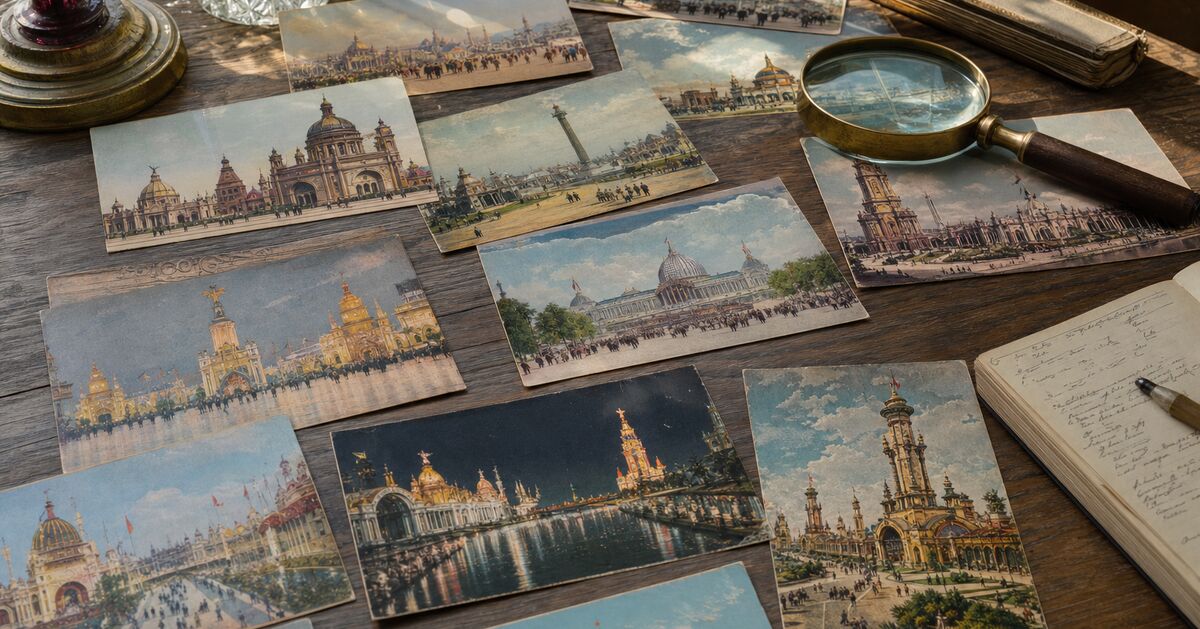
World's fair and exposition postcards rank among the most reliably collectible categories in the hobby - but value swings wildly depending on which event, which subject, which publisher, and what condition the card is in. Generic linen views of the 1939 fair tend to sell cheaply, while scarce real photo cards from lesser-documented fairs like the 1901 Pan-American Exposition can bring much higher prices. Knowing why that gap exists is what turns a casual find into a confident decision about what you're holding.
Why expo postcards attract so many collectors
World's fairs were landmark cultural events, and the postcards produced for them were often the most ambitious printing of their era. Publishers pulled out their best lithographic and photographic technology, paper quality was high, and the subject matter - grand pavilions, exotic international exhibits, cutting-edge machinery, diverse crowds - was simply unlike anything produced for the everyday tourist market.
That combination of historical weight and visual ambition is what keeps collector demand strong. For many American towns and cities, a world's fair was the single biggest event in their history, which means local collectors, history buffs, architectural enthusiasts, and general postcard collectors all compete for the same cards. That overlap in demand is one reason prices hold up better for expo material than for many other categories.
If you want to understand how the broader postcard market works before diving into expo specifics, the postcard price guide lays out the main value factors across all categories.
Which world's fairs actually command premium prices?
Not all expositions are created equal in the eyes of collectors. Here's an honest breakdown of the events that consistently draw serious money - and why.
1893 World's Columbian Exposition, Chicago This is the crown jewel for many expo collectors. The 1893 fair was held just as the picture postcard craze was starting to build in the United States, and the cards produced for it are among the earliest American souvenir postcards in existence. Supply is limited because production was relatively small compared to later fairs. Subject matter includes the famous White City buildings, the Midway Plaisance, and portraits of exhibitors. Clean, undamaged examples tend to sell for a solid premium, with real photo variants or unusual subjects going higher.
1901 Pan-American Exposition, Buffalo, New York The Pan-American is historically loaded - President William McKinley was assassinated on the fairgrounds - and that historical gravity keeps collector interest high. Cards showing the Electric Tower, the Temple of Music (the assassination site), or the Midway are especially sought. The fair also coincided with the era of finest European lithographic printing, so the color quality on many Pan-Am cards is exceptional. Common views tend to sell modestly, while rare subjects or real photos climb well past that.
1904 Louisiana Purchase Exposition, St. Louis One of the largest fairs ever held, St. Louis 1904 generated an enormous number of postcards - which means supply is high and common views are inexpensive. But the sheer variety of subjects (a very large number of documented postcard designs according to some collector references) means that scarce pavilions, ethnic village exhibits, and real photo cards of workers or specific events are still genuinely hard to find and priced accordingly. The exposition postcards page on this site goes into more detail on the range of St. Louis material.
1915 Panama-Pacific International Exposition, San Francisco San Francisco 1915 cards are popular both with expo collectors and with California regional collectors, which creates strong cross-category demand. The fair celebrated the completion of the Panama Canal and the city's recovery from the 1906 earthquake, so the narrative around it is rich. Real photo postcards of the Tower of Jewels, the Zone attractions, and the foreign pavilions draw consistent interest. Linen-era reprints of PPIE images exist and are worth much less - condition and era identification matter here.
1933-34 Century of Progress, Chicago This fair falls squarely in the linen postcard era, and the cards produced for it showcase some of the finest linen printing of the period, with bold Art Deco graphics and striking color. Because linen cards from this fair are still reasonably common, common views are affordable. What drives prices up: real photos, unusual night-scene linens, and cards documenting specific ethnic or industrial exhibits. For a broader look at the linen category, the guide to linen postcards covers what makes one linen card worth more than another.
1939-40 New York World's Fair and 1964-65 New York World's Fair The 1939 fair is more collectible than the 1964 version for one simple reason: age and era. The 1939 cards are mostly linen-era and document the Trylon and Perisphere - two of the most iconic pieces of modernist design in American history. Real photo and early chrome cards of the 1939 fair are especially prized. The 1964 fair produced chrome-era postcards that are still easy to find and inexpensive, though high-grade examples of unusual subjects do attract interest from mid-century collectors. The guide to chrome postcards is worth reading if you're trying to date and assess 1960s expo material.
Smaller regional expositions Don't overlook the smaller fairs. The 1898 Trans-Mississippi Exposition in Omaha, the 1907 Jamestown Exposition, the 1909 Alaska-Yukon-Pacific Exposition in Seattle, and similar regional events often produced smaller postcard runs, which means scarcity is built in. Collectors who focus on a specific region or state actively pursue these because the cards document an event that locals take pride in. Cross-category demand between expo collectors and state/regional collectors pushes prices up for clean examples of these lesser-known events.
What specific subjects within an expo are worth the most?
Even within a single fair, subject matter can move the price dramatically. Here's what to look for:
- Buildings with historical significance - the Hall of Machinery, the Manufactures Building at 1893, the Temple of Music at Pan-Am, the Crystal Palace at later fairs. Any structure tied to a specific historical event commands a premium.
- Foreign and ethnic pavilions - exhibits from countries, indigenous villages, and ethnic communities drew intense attention at the time and are historically charged today. Cards documenting these subjects are actively sought by multiple collector groups.
- Workers, performers, and crowds - real photo postcards showing actual people at work on the fairgrounds, performing in shows, or gathered in crowds are far more personal and far scarcer than architectural views. These are the cards that command the biggest jumps in price.
- Night scenes - expo organizers used electric lighting as a spectacle in itself, especially at the 1901 Pan-Am and the 1933 Century of Progress. Cards that capture illuminated buildings at night, often in difficult-to-print colors, are both beautiful and scarce.
- Disaster and accident documentation - fires, floods, and construction accidents at expo sites were sometimes captured on real photo postcards. These overlap with the broader disaster postcards category, which has its own strong collector base.
- Transportation exhibits - early automobiles, aircraft, and railroad locomotives displayed at fairs were subjects of intense public interest. Cards documenting transportation exhibits crossover into the aviation, railroad, and auto collector markets, creating multiple streams of demand. The guide to railroad postcards explains how that cross-category dynamic affects value.
Does the publisher or printer matter for expo cards?
Absolutely, and this is where newer collectors sometimes leave money on the table or overpay. The major publishers active during the golden age of postcards - Detroit Publishing Company, Raphael Tuck, and Curt Teich - each brought different quality levels and different collector followings to their expo work.
Detroit Publishing produced some of the finest photographic postcards of the 1893 and 1904 fairs, and their backs carry the distinctive Detroit Photographic or Detroit Publishing imprint. Collectors who specialize in Detroit Publishing actively seek expo subjects, so a Detroit-printed 1904 St. Louis card will reliably bring more than an equivalent view by an unknown publisher. The Detroit Publishing Company postcards page explains what to look for on the back.
Raphael Tuck produced high-quality chromolithographic expo cards for the 1893 and earlier fairs, often in their signature embossed or heavily saturated color style. Tuck-printed expo cards appeal to both expo specialists and to Tuck collectors. More detail on identifying Tuck printing is on the Raphael Tuck postcards page.
Curt Teich was a major linen-era printer that produced large quantities of cards for the 1933 and 1939 fairs. Teich cards are identifiable by the "C.T." code printed on the back, and that code can be used to date production runs precisely. Because Teich printed in such volume, common Teich expo views are plentiful. But Teich also produced special runs for specific exhibitors and concessionaires - those smaller print runs are harder to find. The guide to Curt Teich postcards covers the dating system in full.
Does the message on the back matter?
A card mailed from the fairgrounds with the expo's official cancellation stamp is often considered more desirable than the same card unused. An official expo cancellation is direct physical evidence that someone carried that card to the fair, wrote a message, and dropped it in a mailbox on the grounds. That narrative detail appeals to collectors and historians alike.
If the message on the back mentions a specific exhibit, a performer, the food, the heat, the crowds, or anything that documents the fair experience firsthand, it adds further interest. Generic messages ("having a fine time, weather is lovely") add less than a message that describes what the writer actually saw.
For a broader look at how postmarks and used status affect value across all postcard categories, the guide to used vs. unused postcards covers the nuances clearly.
What condition standard applies to expo cards?
Expo cards, especially the pre-1920 chromolithographic examples, are judged by the same grading standards as any other vintage postcard - but collector expectations tend to be stricter because demand is high enough that buyers can afford to be choosy. Corner wear, album peel marks on the back, pen marks from previous cataloging, and toning from poor storage all hurt prices in this category more than in lower-demand areas.
If you're assessing expo cards from an inherited collection, look at corners, the image surface, and the back under good light. Light album damage on the back matters far less than surface creasing or staining on the image side. For the full grading breakdown, the postcard condition guide explains how each type of flaw is weighed.
What to do if you find expo postcards in a collection
If you've come across world's fair or exposition postcards in a larger collection, the right move is to leave the collection as it is and assess it as a whole. Expo cards often traveled alongside souvenir cards from the same trip, local views from the host city, and advertising cards picked up on the fairgrounds - and that context, the grouping itself, can tell a story that adds to the collection's interest and value as a unit.
If you're trying to figure out what to do with a collection that includes expo material, the guide on what to do with old postcards is a good starting point for thinking through your options without rushing into a decision.
The sell page is where you can describe what you have and get an honest email response about what the collection looks like to a collector's eye.
Questions people ask
Are world's fair postcards common or hard to find?
It depends entirely on the fair and the subject. Cards from the 1904 St. Louis fair and the 1939 New York World's Fair were produced in huge quantities and are genuinely easy to find at postcard shows and estate sales. Cards from smaller regional fairs like the 1898 Trans-Mississippi or the 1907 Jamestown Exposition were produced in far smaller numbers and are genuinely scarce. Within any fair, real photo cards of specific subjects - workers, crowds, performers - are always rarer than standard architectural views.
How do I tell if an expo postcard is from the actual era of the fair, or a later reprint?
Look at the back format and printing style first. A card from the 1893 Columbian Exposition will have an undivided back and was likely printed using chromolithography; a "reprint" produced decades later will typically show a divided back or a modern halftone printing pattern visible under magnification. The guide to divided back postcards and the guide to postcard stamp box dating for real photo cards both give practical tools for pinning down age.
Do expo postcards need to be in perfect condition to be worth selling?
No. Condition matters, but scarcity matters more for the rarest subjects. A lightly used, corner-worn real photo of an obscure 1901 Pan-Am ethnic village exhibit is still a highly desirable card because almost nothing exists in comparison. For common views from high-volume fairs, condition becomes more important because buyers have options. The honest answer is that condition always affects price, but it doesn't always determine whether a card is worth pursuing.
What's the best way to find out what a specific expo postcard is worth?
Start by identifying the fair, the subject, the publisher, and the era - all of which are explained in the guides linked throughout this post. Then look at recent completed sales on major postcard platforms to see what comparable cards have actually sold for, not just what sellers are asking. The postcard appraisal page explains when a formal appraisal makes sense versus when market research is enough. For a full collection that includes expo material, describing it as a whole gives you the clearest picture of what you have.
About this guide
- Research: Mike Ferreira
- Last reviewed: November 4, 2026
- Primary references: Government data & agencies 2 · Manufacturer & industry 2 (listed below)
- Claim audit: 8 consequential claims checked against the sources below on Nov 4, 2026; wording the sources could not carry was removed (claim-by-claim)
- Spotted an error? Tell me and I will fix it.
Sources & further reading
- Library of Congress Prints and Photographs - World's Fair postcard collections (Library of Congress)
- National Archives - 1893 World's Columbian Exposition records (U.S. National Archives and Records Administration)
- Chicago History Museum - Century of Progress 1933-34 Exposition (Chicago History Museum)
- Buffalo History Museum - Pan-American Exposition 1901 documentation (Buffalo History Museum)
Revision history (1)
- Nov 4, 2026 - Pre-publish editorial QA: 1 flagged, 1 softened; claim audit: 8 claims, 6 rewritten
Claim-by-claim audit (8 checked)
- “Generic linen views of the 1939 fair tend to sell cheaply, while scarce real photo cards from lesser-documented fairs like the 1901 Pan-American Exposition can bring much higher pr…” (rewritten to what the article can stand behind)
- “Clean, undamaged examples tend to sell for a solid premium, with real photo variants or unusual subjects going higher.” (rewritten to what the article can stand behind)
- “Common views tend to sell modestly, while rare subjects or real photos climb well past that.” (rewritten to what the article can stand behind)
- “One of the largest fairs ever held, St. Louis 1904 generated an enormous number of postcards - which means supply is high and common views are inexpensive.” (reasoning shown in the article)
- “a very large number of documented postcard designs according to some collector references” (rewritten to what the article can stand behind)
- “President William McKinley was assassinated on the fairgrounds” (cited → buffalohistory.org)
- “Curt Teich was a major linen-era printer that produced large quantities of cards for the 1933 and 1939 fairs.” (rewritten to what the article can stand behind)
- “A card mailed from the fairgrounds with the expo's official cancellation stamp is often considered more desirable than the same card unused.” (rewritten to what the article can stand behind)
A question first?
Ask before you send anything
Not sure the collection is worth a quote, or what to photograph? Just ask. Every message comes straight to me, and I answer each one myself.