Dating guide
How to tell when a postcard was made
Turn the card over. The back usually tells you more than the front: the layout, the wording, the stamp box and the postmark can narrow most American postcards to within a decade or two.
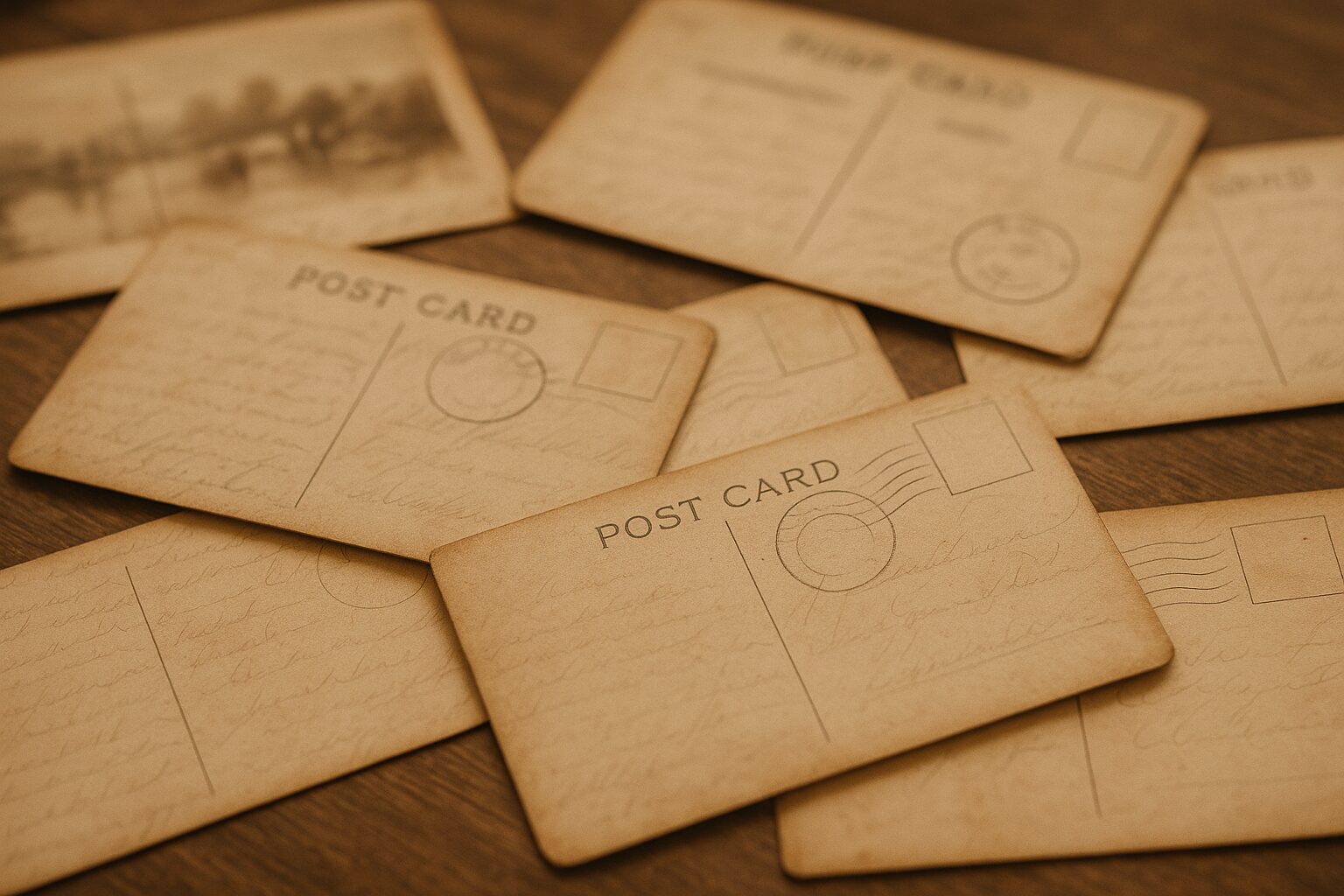
The quick method: a back with no dividing line usually means before March 1907. A divided back with a white-bordered front points to roughly 1915 to 1930. A textured, linen-like surface with bright colors means about 1930 to the early 1950s. A glossy photographic finish is a chrome, from about 1939 onward and mostly after 1950. Real photo postcards span about 1903 to the 1950s and can often be dated by the paper maker's mark in the stamp box.
Start with the back
Until early 1907, U.S. rules did not allow anything but the address on the address side of a postcard. Messages had to squeeze onto the front, around or across the picture. These undivided backs say "Post Card" or "Private Mailing Card" with a blank address side, and they are the earliest cards most collections contain.
From March 1, 1907, a line down the middle of the back allowed a message on the left and the address on the right. This divided back is still the standard today, so it tells you a card is from 1907 or later, but not how much later. For that, look at the front.
Then look at the front
- Full-bleed printed images with no border, often richly colored and sometimes embossed, are typical of about 1907 to 1915, many printed in Germany.
- White borders around the picture became common from about 1915 to 1930, partly to save ink during and after World War I.
- Linen-textured cards with saturated, slightly unreal color, such as the roadside diners and motels people think of as "vintage", date from about 1930 to the early 1950s.
- Chrome cards, glossy and photographic, appeared around 1939 and dominate from the 1950s on.
Postcard eras at a glance
Read the back first, then the front. These are the date ranges collectors commonly use, and production overlapped at every boundary, so treat them as guides rather than rules.
| Era | Years | How to recognize it |
|---|---|---|
| Private mailing card | 1898 to 1901 | The words "Private Mailing Card" on the back, with room for the address only |
| Undivided back | 1901 to March 1907 | "Post Card" on a back with no dividing line; any message is written on the front |
| Divided back | From March 1, 1907 (the golden age runs to about 1915) | A line down the middle of the back, message on the left and address on the right; fronts often printed edge to edge in rich color |
| White border | About 1915 to 1930 | A white frame around the picture on the front |
| Linen | About 1930 to the early 1950s | A textured, fabric-like surface with bright, saturated inks |
| Chrome | From about 1939, dominant after 1950 | A glossy, photographic-looking color surface |
| Real photo | About 1903 into the 1950s | A true photograph with no printing dots; the stamp box often names the photo paper maker |
Real photo postcards
Real photo cards do not fit the printed-card eras neatly, because they were printed on photo paper by photographers throughout the period. The backs help instead. Photo paper makers printed their name or a pattern in the stamp box, and the designs changed over time. One widely cited example: AZO paper with four triangles pointing up in the corners of the stamp box is generally dated from about 1904 to 1918, while AZO with squares in the corners is generally later, into the 1930s and 1940s. Collectors use published charts of these marks for VELOX, CYKO, KRUXO, EKC, DOPS and others. The ranges are approximate, but they narrow a card down quickly.
Other clues on a real photo card: early cars or clothing in the scene, a dated caption scratched onto the negative, a written date in the message, and the postmark.
The postmark and the stamp
A postmark gives you the latest possible date the card could have been made, since it had to exist before it was mailed. The stamp helps too: one-cent postcard rates applied for most of the early period, with a temporary two-cent rate during World War I (from late 1917 into 1919), and later rate changes in the 1950s. A stamp is rarely valuable on its own, but it is a useful timestamp.
Sources and further reading
The eras at a glance
American postcard eras
Dates are the ones collectors commonly use. Production overlapped at every boundary, so treat them as guides, not rules.
Before 1898
Pioneer cards
Government postal cards and early souvenir cards, including those from the 1893 Columbian Exposition in Chicago.
1898 to 1901
Private mailing cards
Privately printed cards that had to carry the words "Private Mailing Card" on the back.
1901 to 1907
Undivided backs
"Post Card" on the back, address only. Messages were written on the picture side.
1907 to about 1915
Divided backs
The golden age. Message and address share the back; much of the finest printing came from Germany.
About 1915 to 1930
White borders
A white frame around the picture. Real photo postcards remained popular throughout.
1930 onward
Linens, then chromes
Textured linen cards to the early 1950s; glossy chromes from about 1939 and dominant after 1950.
Common mix-ups
Four things that can mislead you
A few patterns trip people up when they first try to date a collection.
Old image
The picture is older than the card
Publishers reused old photographs for years. Date the card from its back and finish, not the scene.
Reprints
Modern copies exist
Reproductions of vintage images are sold as souvenirs. Bright white modern card stock is the giveaway.
Unused
No postmark is normal
Many cards were bought and never mailed. Unused cards are dated by their printing, not missed postmarks.
Stamp box
Marks are ranges
Paper maker marks narrow a real photo card to a span of years, not an exact date.
Reading the printing on the back
Beyond the overall layout, small printed details on the back help narrow the date.
The wording. Early cards sometimes say "Private Mailing Card" with a reference to the Act of Congress of May 19, 1898, which places them around 1898 to 1901. "Post Card" or "Postal Card" with an undivided back points to roughly 1901 to 1907. Instructions such as "This side for the address only" also suggest the early years.
The publisher's line. Many cards name the publisher and where they were printed. "Printed in Germany" or "Made in Saxony" is typical before 1915. A Chicago, Boston or New York publisher with a long series number may be later. Publisher logos changed over time, and collectors keep references of them.
The stamp box. Printed cards often carried a stamp box with "Place stamp here" and the postage rate for domestic and foreign mail. On real photo cards the stamp box is where the photo paper maker's mark appears.
None of these is exact on its own. Taken together with the front, they usually tell a consistent story.
If a card carries a copyright line with a year, that year is a good starting point, though publishers sometimes kept reprinting a design long after.
You do not have to date them yourself
Dating cards is a pleasant rabbit hole, and many collectors love it. But if you are selling, you do not need to sort a collection by era before asking for a quote. A few photos of the backs are enough for me to see what you have, and I will tell you in the quote what eras the collection covers.
If you do want to explore, start with the backs. Sort a handful into undivided, divided with a picture to the edge, white border, linen and chrome. Within ten minutes you will have a good sense of the collection's range.
One caution while you handle them: hold cards by the edges, keep them away from damp, and do not write on them, even in pencil. A card's condition is part of its value.
And if you come across something you cannot place at all, such as an odd size, an unusual material like leather, wood or aluminum, or a card with something attached to it, set it aside and photograph it. Novelty cards like these were popular in the early 1900s and some are quite collectible.
You never pay to ship, and you never sell at a price you didn't agree to
Once you accept the quote, I email a prepaid, insured shipping label. When the postcards arrive I go through them and pay you within two business days.
If what arrives is different from the photos and my offer has to change, you can say no, and I ship everything back to you at my expense.
- PayPal
- Check by mail
- Zelle
- Venmo
Frequently asked questions
- How can I tell a real photo postcard from a printed one?
- Look at the picture under a magnifier. A printed card shows tiny dots or a screen pattern; a real photograph is smooth, continuous gray. Real photo cards often have a paper maker's name such as AZO or VELOX in the stamp box, and many have white hand-lettered captions on the picture.
- What is an RPPC?
- A real photo postcard: an actual photograph developed on photo paper that had a postcard back printed on it. They were made from about 1903 into the 1950s, often by local photographers in small numbers, and they are the most collected kind of American postcard. See the RPPC page.
- What if I have no idea what I have?
- That's a very common situation, and it's fine. Describe what you can see in plain words (albums or boxes, roughly how many, black and white photographs or colored prints) and add a few photos. I'll tell you what it is.
- Are postcards with writing on the back worth less?
- Generally no. Most collectors are happy with used cards, and a message or a clear postmark can add interest. What lowers value is damage to the front: creases, tears, stains, tape or glue.
- What are old postcards worth?
- Most printed views, and most cards from the 1930s on, are worth well under a dollar each in quantity. Real photo postcards of identifiable small towns, businesses, occupations, transportation and events are often worth several dollars to tens of dollars each, and rare ones more. The values guide explains why.
A question first?
Something here you want to ask about?
Send a question about a card, an album or a whole estate. You don't need to be ready to sell to ask.