Topicals and advertising
Trains, trades, fairs and front-page events
Collectors who never think about a particular town will pay attention to a good card of a steam engine, a lumber crew, an early garage or a world's fair building. These subject cards, called topicals, are a big part of what makes a collection valuable.
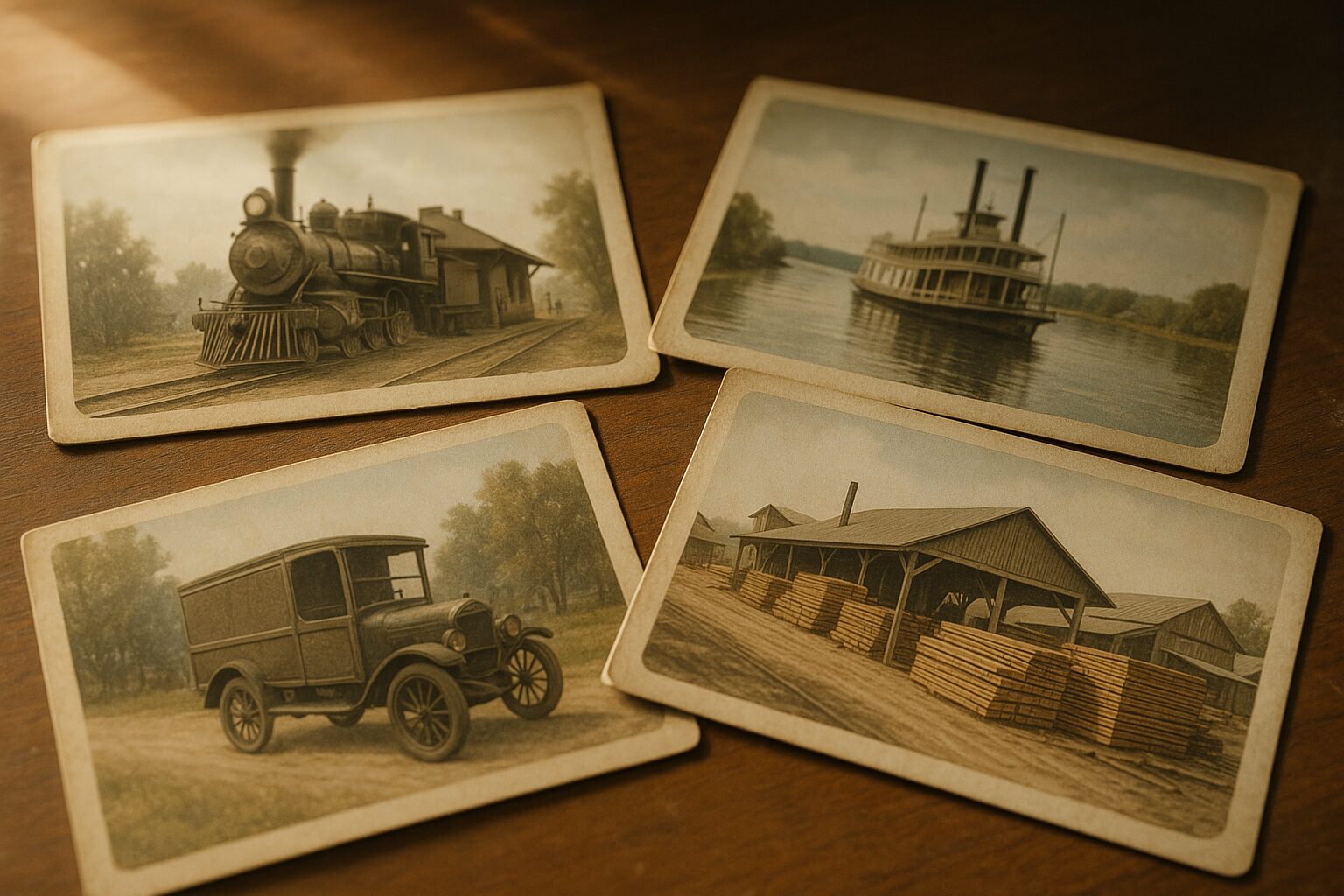
What topicals are: postcards collected for their subject rather than their place. The strongest categories are transportation (railroads, depots, trolleys, early automobiles, aviation, ships), occupations and industry, advertising, disasters, and events such as expositions, fairs and parades. Real photo topicals are usually the most valuable, and cards that show people at work or a specific event are wanted most.
Transportation
Transportation is one of the largest collecting fields of all, and it overlaps with town views. A depot is a town view and a railroad card at once, which is part of why depot cards are so wanted.
- Railroads: depots with trains and people, engines and crews, wrecks, bridges, roundhouses, interurban and trolley lines.
- Early automobiles: garages and filling stations, auto races, the first car in town, early buses and trucks, dealer advertising cards.
- Water: steamboats at the landing, ferries, lake excursion boats, Great Lakes freighters, canal scenes.
- Aviation: early flying meets, airships and balloon ascensions, often around 1910 to 1915.
Occupations and industry
Work was a favorite subject of local photographers. Crews posed for the camera at the mine portal, beside the threshing machine or in front of the mill, and the resulting cards are among the best documents of how ordinary people earned a living.
Look for mining, logging and lumber camps, oil fields, quarries, fishing, creameries, blacksmiths, harness makers, barbers, telephone exchanges, fire companies with their equipment, police departments and mail carriers. Interior views of shops and offices are particularly good.
Advertising
Businesses used postcards as mailers and handouts: implement dealers, seed companies, insurance agents, hotels, breweries, tobacco and patent medicine makers. Many were printed in small runs for a single local company. Cards picturing the product or the storefront, and cards with a business's own name printed on the back, are both of interest.
Disasters and events
When something happened, a photographer was usually on the scene within a day, and real photo cards of the event were on sale within a week. Floods, fires, tornadoes, train wrecks, building collapses and storms all appear, as do happier events: county fairs, parades, Chautauquas, circuses arriving by rail, political rallies and reunions.
Expositions produced official card sets in large numbers, from the 1893 Columbian Exposition in Chicago through the 1904 St. Louis World's Fair, the 1915 Panama-Pacific in San Francisco and the 1939 New York World's Fair. Common exposition cards are plentiful; unusual views and early official cards are better.
What collectors chase
Four topical traits that matter
Within any subject, the same few qualities separate the ordinary card from the one a specialist wants.
Close up
The subject fills the frame
A locomotive filling the card beats a distant train in a landscape.
Identified
Names and places
A railroad name, a business sign, a caption with a town and date. Identification adds value.
People
Workers and crowds
Crews posing with their equipment, crowds at the fair. Human interest is always a plus.
Real photo
Photographs over print
In almost every topic, a real photo card is scarcer than the printed version.
Specialist collectors and why they matter to you
Topicals have something town views do not: collectors who never care where a card came from. A railroad historian wants the depot whatever state it is in. A collector of fire apparatus wants the hose company posing with its new engine. A mining enthusiast wants the miners at the mouth of the shaft. That breadth of demand is why topicals can carry so much of a collection's value.
Some topics overlap with other fields entirely. Advertising cards interest collectors of the brands themselves. Exposition cards draw people who collect everything from a single fair, including tickets and souvenirs. Political and patriotic cards, early aviation and baseball team cards all have followings of their own.
A few topics are especially strong right now:
- Depots and railroad structures, especially real photo views with a train present.
- Early automobiles and garages, including gas stations, auto dealers and the first car in a town.
- Occupational real photos, people at work with their tools, animals or machines.
- Main street disasters and events: fires, floods, tornadoes and the crowds that gathered afterward.
- Interiors: the inside of a store, a saloon, a bank, a print shop or a school room.
Cards that combine two of these, such as a depot crowded for an event or a garage interior with mechanics at work, are often the best in a collection. If you spot cards like that while flipping through the albums, set a few aside for your photos. I would rather see them than guess at them.
Advertising postcards deserve a second glance, too. A card that looks like a plain view of a farm implement or a hotel may carry a printed message from a local dealer on the back, offering a sale or announcing a new line. Those private-printed messages tie a card to a particular business in a particular town, and that is exactly the kind of detail specialist collectors value.
Subject collections and mixed boxes
Some collectors built focused topical collections over a lifetime: every railroad depot in a state, every fire company they could find, a complete exposition set. If yours is one of those, tell me the theme on the form. A well built subject collection is worth more kept together, and I buy it that way.
More often, topicals are scattered through an album or a box among views and greetings. That is fine. I go through every card when the lot arrives, and the topicals are part of what I am looking for in your photos.
Photograph a few of the subject cards you notice, plus a couple of album pages chosen at random. That combination gives me the clearest idea of the whole collection.
One more tip: topicals are often hiding in plain sight. A town view of main street may have a streetcar in it, a parade going past, or a delivery wagon with the business name painted on the side. Those details are what turn an ordinary view into a topical card, and I look for them on every page. If you see something interesting in the background of a card, it is worth a photo of its own.
I also buy collections where the topicals are the whole point, including large railroad and transportation collections built by a single enthusiast over decades.
Topicals are some of my favorite cards to come across, because each one is a little piece of somebody's working life or a big day in their town. If you spot a subject you can't name, just describe what you see in plain words, and I'll happily tell you what I think it is.
You never pay to ship, and you never sell at a price you didn't agree to
Once you accept the quote, I email a prepaid, insured shipping label. When the postcards arrive I go through them and pay you within two business days.
If what arrives is different from the photos and my offer has to change, you can say no, and I ship everything back to you at my expense.
- PayPal
- Check by mail
- Zelle
- Venmo
Frequently asked questions
- What kinds of old postcards do you buy?
- Real photo postcards above all, especially small-town streets, storefronts, occupations and transportation. Also town views, embossed holiday cards (Halloween especially), topicals such as railroads, early cars, advertising, disasters and expositions, and whole inherited or estate collections. See what I buy.
- What is an RPPC?
- A real photo postcard: an actual photograph developed on photo paper that had a postcard back printed on it. They were made from about 1903 into the 1950s, often by local photographers in small numbers, and they are the most collected kind of American postcard. See the RPPC page.
- Are postcards with writing on the back worth less?
- Generally no. Most collectors are happy with used cards, and a message or a clear postmark can add interest. What lowers value is damage to the front: creases, tears, stains, tape or glue.
- What if I have no idea what I have?
- That's a very common situation, and it's fine. Describe what you can see in plain words (albums or boxes, roughly how many, black and white photographs or colored prints) and add a few photos. I'll tell you what it is.
- Do you buy foreign postcards?
- When they come mixed into an American collection, yes. My focus is United States cards, but I take foreign cards along with the rest of the lot.
- Do you buy small lots or single cards?
- My focus is collections and large lots, but a smaller group of good real photo postcards, early holiday cards or strong topicals is welcome. A handful of common printed views usually isn't worth shipping, and I'll tell you so honestly.
A question first?
Something here you want to ask about?
Send a question about a card, an album or a whole estate. You don't need to be ready to sell to ask.