Real photo postcards
Real photo postcards are what I want most
Photographs printed straight onto postcard paper, made in the millions between about 1905 and the 1950s. The best of them are the only pictures that exist of a small town's main street, a family business or a moment in a place's history.
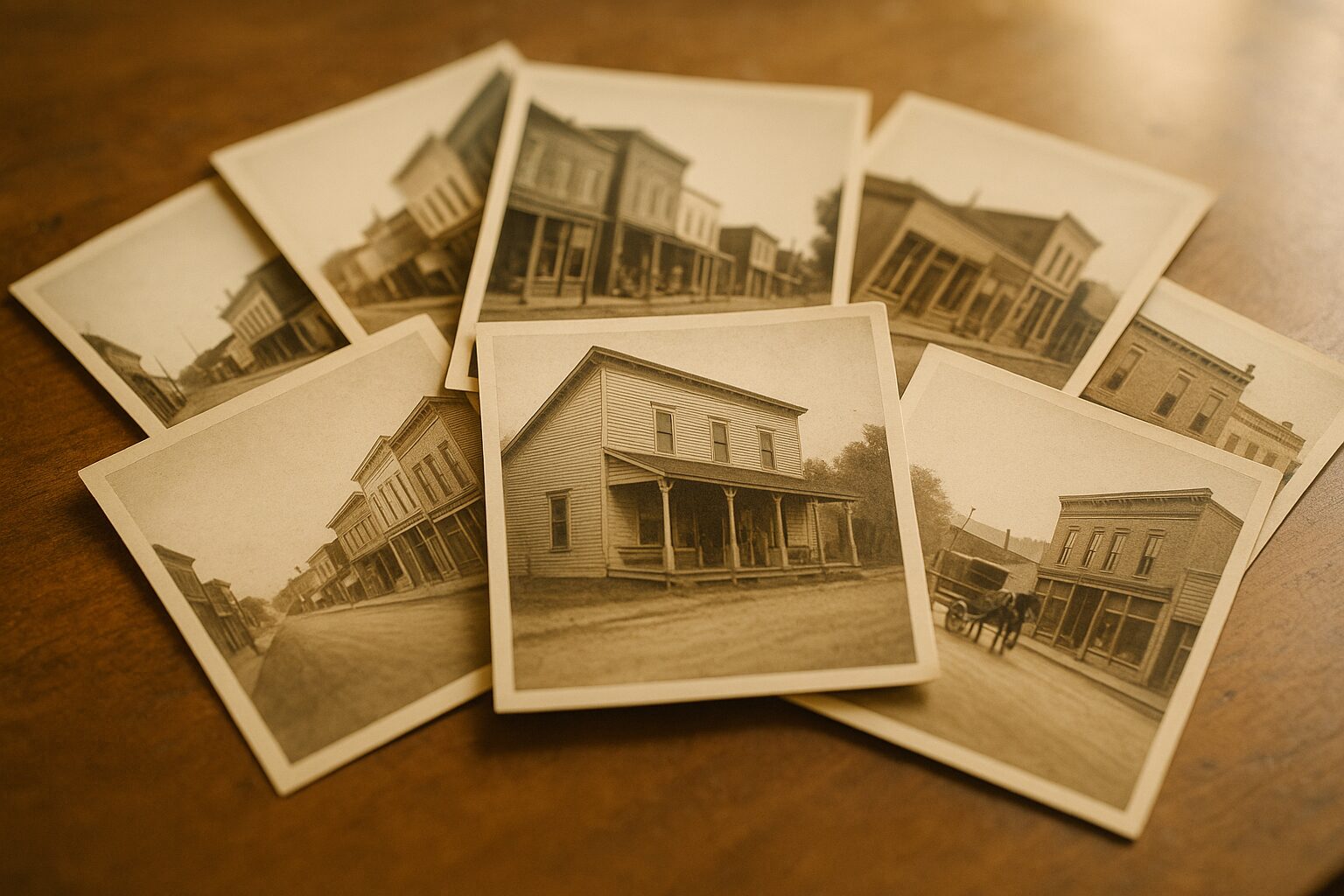
What is an RPPC? A real photo postcard is an actual photograph, developed on light-sensitive paper that was manufactured with a postcard back already printed on it. Kodak made it easy for anyone to do this from about 1903, so traveling photographers, local studios and ordinary amateurs photographed their own towns and sold or mailed the results. Because many were made in small numbers, a good RPPC of a little town can be scarce, and they are the most collected category of American postcard.
To learn how collectors price them, see what real photo postcards are worth. To date one from the back, see dating a postcard by its stamp box and the wider guide to dating old postcards.
Why real photo cards matter so much to collectors
A printed postcard of a city street was usually produced by a big publisher in runs of thousands. A real photo postcard of the same kind of scene was often made by one local photographer, who printed only as many as the drugstore or general store thought it could sell. Some runs were a few dozen cards. That is why two cards that look similar in an album can be worth very different amounts.
Real photo cards also show things printed cards rarely did. The local photographer went where the town was: the ball team posed on the bleachers, the crew standing in front of the sawmill, the flood that took out the bridge, the new automobile parked outside the hardware store, the one-room school with every pupil lined up. Those are the pictures that local historical societies, family researchers and topic collectors look for.
How to tell a real photo from a printed card
You do not need special tools, though a cheap magnifier helps.
- Look closely at the picture. A printed card is made of tiny dots or a regular screen pattern, visible under magnification. A real photograph is continuous tone: smooth grays with no dots at all.
- Look at the surface. Many RPPCs have the slight sheen of photo paper. Tilt the card under a light. Some have a silvery haze in the dark areas called silvering, which happens to old silver-gelatin prints.
- Look at the back. Real photo paper was sold with the postcard back pre-printed. The stamp box often carries the paper maker's name or initials, such as AZO, VELOX, CYKO, KRUXO, EKC or DOPS, sometimes with small triangles, squares or diamonds in the corners.
- Look at the caption. Many RPPC captions were scratched or hand-lettered onto the negative, so they appear as white handwriting on the picture itself, often with a number or the photographer's name.
What I look for in an RPPC collection
Everything gets counted, but these are the cards that move a quote the most:
- Main streets and business districts, especially in small towns, with people, wagons or early cars in the scene.
- Storefronts and interiors: the barber shop, the general store, the saloon, the bank counter, the post office with the postmaster at the window.
- Occupations and industry: mines, lumber camps, mills, creameries, threshing crews, blacksmiths, telephone operators.
- Transportation: depots with the train in, trolleys, early automobiles and garages, steamboats at the landing, early aviation.
- Events: floods, fires, train wrecks, tornado damage, parades, Chautauquas, county fairs, Fourth of July celebrations.
- Identified people and places: cards with a clear caption, or a written message that names the place, are easier for a collector to use and often worth more.
Portrait RPPCs of unidentified people in a studio are the most common real photo cards and usually the least valuable, though a large group of them still adds up, and unusual ones (a family with its pets, people in costume, an interesting occupation) can be very good.
Sources and further reading
What raises an RPPC's value
Four things I check on every real photo card
None of these needs expertise to spot. If you notice them in your collection, mention them on the form.
Place
Can the place be identified?
A caption, a sign in the picture, or a postmark from a small town lets a collector place the card. Identified beats anonymous.
Subject
Is something happening?
Work, business, transportation, an event. Activity and people make a card far more wanted than an empty view.
Clarity
Is the photo sharp?
A crisp image with good contrast is worth more than a faded or blurry one of the same scene.
Condition
Is the card intact?
Corners, creases, stains and album residue on the back matter. Writing and postmarks do not hurt.
Who made real photo postcards
Three kinds of photographer produced most of the real photo cards that survive.
Local studio photographers sold views of their own town through the drugstore, the stationer and the depot newsstand, and they photographed every event worth remembering. Their cards often carry a studio name on the back or a neat hand-lettered caption on the front.
Traveling photographers worked a region by wagon, train and later by car, spending a few days in each town, photographing main street, the school and the businesses, and moving on. Their numbered captions sometimes run in long series across a whole county, and collectors love finding the missing numbers.
Amateurs with folding cameras printed their own cards at home or through a drugstore, because postcard paper made it easy to mail a snapshot. Family pictures, farm scenes, a new barn, a car trip: these are the cards nobody else could have made, and they turn up in nearly every family album.
If you notice the same studio name or the same style of caption across many cards in your collection, mention it. A run of work by one photographer is something collectors in that area pay attention to.
A photographer's stamp on the back, or a studio name written on the negative, is one of the small details that makes a card easier to place and date, and it is worth noticing as you look through a collection.
If you have an album of real photos
Leave the cards where they are. Some albums were assembled by one family over a generation, and the order of the pages tells a story about where they lived and traveled. Collectors value that context, and removing the cards can damage them, especially if they are held by old glue or photo corners.
Photograph the album closed, then open it to a few random pages and shoot straight down in daylight. Turn over two or three loose cards if you have any, so I can see the backs. That is enough for a fair quote on most real photo collections.
If the cards are of one town or one county, say so in the description. A group from a single place is often worth more together than the same cards scattered among other lots, and it is the kind of collection I most enjoy finding.
For loose real photo cards, standing them upright in a box is fine. Avoid rubber bands, which stain, and paper clips, which dent.
You never pay to ship, and you never sell at a price you didn't agree to
Once you accept the quote, I email a prepaid, insured shipping label. When the postcards arrive I go through them and pay you within two business days.
If what arrives is different from the photos and my offer has to change, you can say no, and I ship everything back to you at my expense.
- PayPal
- Check by mail
- Zelle
- Venmo
Frequently asked questions
- What is an RPPC?
- A real photo postcard: an actual photograph developed on photo paper that had a postcard back printed on it. They were made from about 1903 into the 1950s, often by local photographers in small numbers, and they are the most collected kind of American postcard. See the RPPC page.
- How can I tell a real photo postcard from a printed one?
- Look at the picture under a magnifier. A printed card shows tiny dots or a screen pattern; a real photograph is smooth, continuous gray. Real photo cards often have a paper maker's name such as AZO or VELOX in the stamp box, and many have white hand-lettered captions on the picture.
- What kinds of old postcards do you buy?
- Real photo postcards above all, especially small-town streets, storefronts, occupations and transportation. Also town views, embossed holiday cards (Halloween especially), topicals such as railroads, early cars, advertising, disasters and expositions, and whole inherited or estate collections. See what I buy.
- What if I have no idea what I have?
- That's a very common situation, and it's fine. Describe what you can see in plain words (albums or boxes, roughly how many, black and white photographs or colored prints) and add a few photos. I'll tell you what it is.
- Are postcards with writing on the back worth less?
- Generally no. Most collectors are happy with used cards, and a message or a clear postmark can add interest. What lowers value is damage to the front: creases, tears, stains, tape or glue.
A question first?
Something here you want to ask about?
Send a question about a card, an album or a whole estate. You don't need to be ready to sell to ask.