Holiday and greeting postcards
Embossed, gilded and beautifully printed
Before about 1915, Americans mailed holiday greetings by the hundreds of millions, and many of the cards were small works of art printed in Germany. Halloween cards are the most sought after, but every holiday has its collectors.
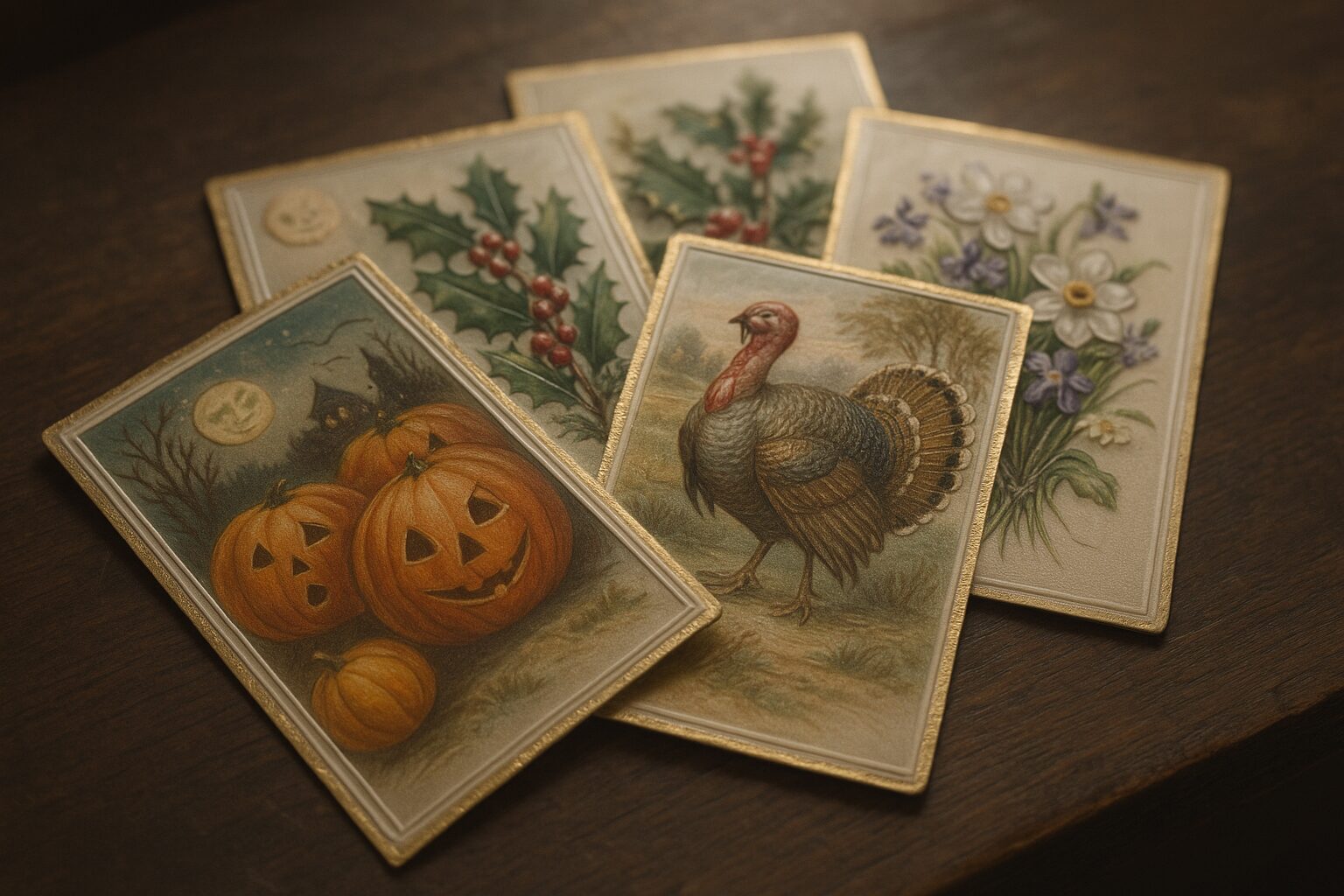
What sells: Halloween postcards from roughly 1905 to 1920 are the most valuable holiday cards as a group, especially those with jack-o'-lanterns, witches, black cats and children in costume. Cards signed by known artists, such as Ellen Clapsaddle and Frances Brundage, and cards from publishers like John Winsch, are widely collected. Christmas, Thanksgiving and Easter cards are far more common, so condition, artistry and unusual designs decide their value.
The golden age of the greeting postcard
The U.S. Post Office allowed messages on the address side of a postcard starting in 1907, and the timing was perfect. Color lithography had reached a high point, German printers could produce richly embossed cards cheaply, and sending a postcard for every holiday became a national habit. Albums from those years are often full of them, saved by grandmothers who kept every greeting the family received.
World War I ended the German supply, and American printers never matched the old embossing and color. That is why so many collectors focus on cards from roughly 1907 to 1915, and why an album from those years can hold more value than its owner expects.
Halloween first
Halloween was a smaller holiday then, and far fewer Halloween cards were sent than Christmas cards. Today they are among the most wanted postcards of any kind. Look for:
- Jack-o'-lanterns with faces and bodies, goblins, witches on brooms, black cats and owls.
- Children in costume or bobbing for apples.
- Mechanical cards with moving parts, and cards with silk, feathers or other attached materials.
- Series cards from known publishers, often numbered on the back.
Other holidays worth mentioning
- Christmas. The most common holiday card by far. Santa in unusual colors (a blue, green or purple suit), Santa with early cars or airships, and finely embossed hold-to-light cards stand out.
- Thanksgiving. Turkeys, pilgrims and harvest scenes; patriotic designs with Uncle Sam are especially collected.
- Easter. Chicks, rabbits and children, often embossed. Dressed animals and unusual designs lift them.
- Valentine's Day, St. Patrick's Day, Fourth of July, New Year and Leap Year. Each has collectors; Fourth of July and Uncle Sam designs are particularly wanted.
- Greetings and birthdays. Usually the most common cards in an album, and they count at a lower rate.
Artist-signed cards
Some illustrators signed their postcard designs, and those names are collected on their own. Ellen Clapsaddle, Frances Brundage and Samuel Schmucker are among the best known for holiday cards. A signature in the corner of the picture is worth pointing out on the form, but I will spot them in your photos too.
Sources and further reading
Holiday card value
What separates a great holiday card from a common one
Most holiday cards are common. A smaller group carries the value, and these four traits usually mark them.
The holiday
Halloween above all
Fewer were made and more people collect them. Fourth of July and Thanksgiving follow; Christmas is most common.
The printing
Embossed, gilded, layered
Deep embossing, gold highlights and bright original color point to the best pre-war printing.
The design
Unusual subjects
Odd colors, early technology, dressed animals, mechanical parts. Anything unexpected draws collectors.
The condition
Bright and unworn
Faded color, rubbed embossing and corner wear lower value. A handwritten greeting does not.
How holiday cards were made and why it shows
The finest holiday postcards were produced with a process called chromolithography, printing each color from a separate stone or plate, sometimes a dozen or more. The cards were then embossed, pressing the design into the card so figures and borders stand up in relief, and some were finished with gold or silver powder, glitter, or attached materials such as silk and feathers.
You can feel the difference. A deeply embossed Halloween card from around 1910 has a texture modern printing does not reproduce, and the color sits in rich, even layers rather than in visible dots. Later American cards from the late 1910s and 1920s are flatter and simpler, though some publishers kept up surprisingly good quality.
Publishers matter. Collectors recognize the work of firms like Raphael Tuck, John Winsch, International Art Publishing and others. The publisher's name, a trademark, or a series number on the back helps identify a card and sometimes its artist, even when the design is unsigned.
Sets and series matter too. Many holiday cards were issued in numbered sets of four, six or twelve designs. A collection holding several cards from the same series, or a complete set, is more interesting to a collector than the same cards scattered.
What lowers value: rubbed embossing, where the high points have worn white; heavy fading from years in sunlight; corners rounded or torn by album slots; and gold that has flaked away. A small amount of wear is normal for a card well over a hundred years old, and I allow for it.
If your collection has holiday cards, the single most useful thing you can do is photograph a group of them together, front side up, in good daylight. I can usually tell a great deal about the era and quality from that one picture.
Finally, keep an eye out for novelty construction: cards with a separate layer that folds out, a wheel that turns, a small envelope with a tiny card inside, or a panel that opens like a door. These mechanical and novelty holiday cards were made in smaller numbers and survive less often in working order, so they draw attention from specialist collectors even when the design is otherwise ordinary.
Holiday cards in a family album
Holiday cards rarely come by themselves. They usually fill the back half of a family album or a box of correspondence, mixed with views and birthday greetings. That is the normal shape of a collection and exactly what I buy: you do not need to separate the holiday cards out.
For the photos, open the album to two or three random pages and shoot straight down, then photograph a few of any Halloween cards you notice, close up, without taking them out of the album. If there are a lot of holiday cards, one photo of a dozen of the best is plenty.
One caution: do not try to clean a dirty holiday card or flatten a curled one. Gold and embossing damage easily, and a card left alone is better than one that has been scrubbed.
The same goes for the envelopes and postcard albums the cards came in. A period album with gilt pages or a decorative cover adds a little interest of its own, and keeping the cards inside it protects them on the way to me. If a few holiday cards are loose in a box, slip them between two pieces of cardboard so the embossing is not crushed in transit.
You never pay to ship, and you never sell at a price you didn't agree to
Once you accept the quote, I email a prepaid, insured shipping label. When the postcards arrive I go through them and pay you within two business days.
If what arrives is different from the photos and my offer has to change, you can say no, and I ship everything back to you at my expense.
- PayPal
- Check by mail
- Zelle
- Venmo
Frequently asked questions
- What kinds of old postcards do you buy?
- Real photo postcards above all, especially small-town streets, storefronts, occupations and transportation. Also town views, embossed holiday cards (Halloween especially), topicals such as railroads, early cars, advertising, disasters and expositions, and whole inherited or estate collections. See what I buy.
- Are postcards with writing on the back worth less?
- Generally no. Most collectors are happy with used cards, and a message or a clear postmark can add interest. What lowers value is damage to the front: creases, tears, stains, tape or glue.
- Do you buy chrome or modern postcards?
- Inside a larger older collection, yes, I take them with everything else. A collection of only glossy chrome cards from about 1960 onward has very little resale value, so I usually decline those on their own.
- What if I have no idea what I have?
- That's a very common situation, and it's fine. Describe what you can see in plain words (albums or boxes, roughly how many, black and white photographs or colored prints) and add a few photos. I'll tell you what it is.
- Do you buy small lots or single cards?
- My focus is collections and large lots, but a smaller group of good real photo postcards, early holiday cards or strong topicals is welcome. A handful of common printed views usually isn't worth shipping, and I'll tell you so honestly.
A question first?
Something here you want to ask about?
Send a question about a card, an album or a whole estate. You don't need to be ready to sell to ask.