Inherited and estate collections
You found the postcard albums. Now what?
Many collections are sold by someone who did not build them: a son or daughter, a grandchild, an executor clearing a house. You do not need to know anything about postcards to get a fair offer. Here is how to approach it.
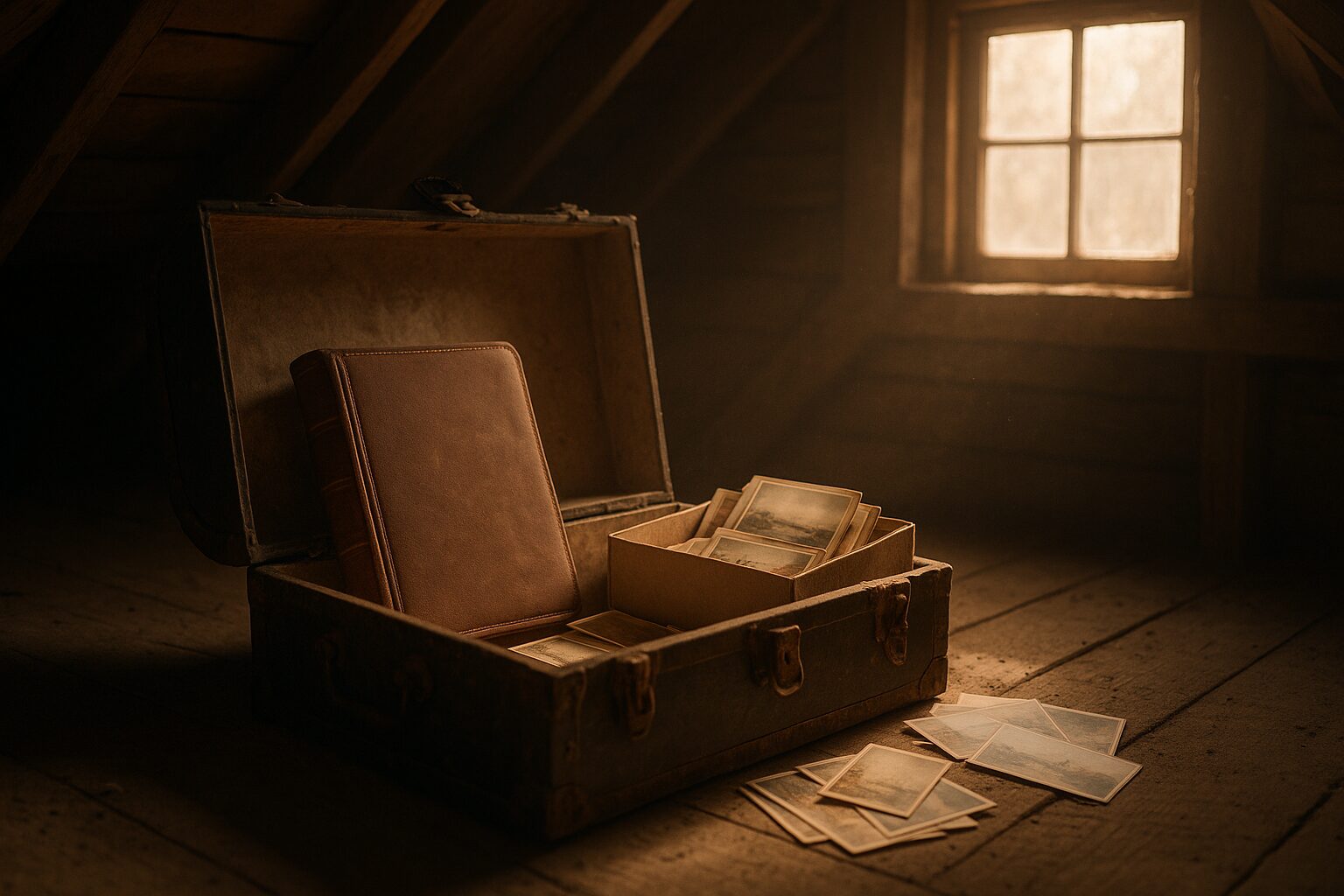
What to do first: leave the collection the way you found it. Do not pull cards out of albums, split the lot among relatives before anyone has looked, or throw away cards that look ordinary. Take a few photos, describe what you see, and get a quote for the whole thing. Knowing what it is worth as a whole helps the family decide whether to sell it.
Why "leave it as it is" matters
A collection put together by one person over years has a shape. The albums may follow a trip, a county, a family's moves, or the collector's own interests. That context helps a buyer judge it, and it often makes the whole worth more than its parts.
The cards that look plainest are sometimes the important ones. A small, grayish real photograph of a general store can be worth far more than a bright color card of a famous building, and nobody would guess that from a quick look. When families sort a collection before getting it valued, the common colorful cards tend to be kept and the plain old photographs tossed, which is exactly backwards.
How to describe a collection you know nothing about
You do not need postcard vocabulary. Tell me what you can see, in plain words:
- How it is kept: albums, shoeboxes, file drawers, dealer boxes with dividers, a trunk.
- Roughly how many: count one album page and multiply by the number of pages, or estimate a full shoebox at around eight hundred to a thousand cards.
- What is on them: "lots of small towns in Pennsylvania", "mostly black and white photographs", "a stack of old Halloween cards", "souvenirs from trips in the 1950s".
- Anything written down: labels on the boxes, notes in the albums, a list the collector kept.
- Who collected it and when, if you know.
Then take the four photos described on the quote page: the whole lot, a few album pages laid flat, a handful of cards that catch your eye, and the backs of two or three.
Why I only buy the whole collection
My quote is always for the complete collection, as it was found. That is not a technicality. When the best cards are taken out first, what remains is worth far less, and often the cards a family picks are not the valuable ones anyway: a bright view of a famous hotel gets kept while a plain gray photograph of a crossroads store, worth many times more, goes in the box. Pricing the whole collection lets me pay fairly for everything in it, including the ordinary cards that would be hard to sell alone.
If the family decides to hold on to the collection, that is entirely your choice, and there is no cost for having asked. Keep it together, stored dry and out of the sun, and the offer to look again is open whenever you are ready.
Executors and estate sales
If you are settling an estate, a written offer for the collection gives you a clear figure for the records, and payment by check or electronic transfer gives you a paper trail. Estate sale companies often price postcards by the box for quick sale. Before a collection goes into a sale, it is worth getting a separate quote, because a box priced at a few dollars can hold cards a collector would value far more highly.
Sources and further reading
Making it easy
What I handle so you do not have to
Selling a collection you did not build should not become another project in an already busy time.
Sorting
I do the sorting
Send the boxes as they are. Identifying, counting and grading is my job, not yours.
Shipping
Labels are prepaid
Insured labels for every box, so there is nothing to buy and nothing to weigh at the post office.
Records
Everything in writing
The quote, the acceptance and the payment confirmation all arrive by email, ready for the estate file.
Pace
No pressure to decide
Take the time the family needs. Ask questions and compare offers before you decide.
Common questions from families
Grandmother wrote on the backs. Is that a problem? No. Messages are part of the history, and collectors generally like them. Never try to erase writing.
Some cards are glued into the album. Should I try to get them out? Please do not. Leave them in place. Removing glued cards almost always damages them, and I can value an album with the cards where they are.
The cards smell musty. Can I air them out? Gentle airing in a dry room is fine. Avoid direct sunlight, heat and any kind of cleaning spray. If there is visible mold, keep those cards apart from the rest and mention it on the form.
There are also old photographs, letters and other paper in the boxes. Mention them. I focus on postcards, but related paper often travels with a collection and I will tell you honestly whether I can include it.
Several relatives want a say in the decision. A written quote by email is easy to forward to everyone. There is no deadline from my side, so the family can talk it over.
I found postcards in several places around the house. Should I gather them together? Yes, gather loose cards and boxes in one place so you can describe the whole collection, but keep albums as they are and do not mix cards between them. If some boxes were clearly labeled by the collector, keep the labels with them.
When the collection is very large
Some estates hold tens of thousands of cards: a dealer's stock, or a lifetime of buying boxes at auctions. Those are welcome. Photograph every box or album, or as many as practical, and give me the best count you can. I may ask for a few more pictures before quoting.
Shipping simply means more labels, one per box, and I pay for the whole collection once it all arrives. If shipping many heavy boxes is a problem for you, mention it on the form and I will help you find a way to make it manageable.
And if, after all that, the collection turns out to be mostly common modern cards with little resale value, I will tell you plainly. That is useful to know too.
Finally, there is no right or wrong time to sell. Some families decide within days; others keep a collection in a closet for years before they are ready. Postcards that are stored dry and away from sunlight keep perfectly well in the meantime, and my offer to look is open whenever you want it.
You never pay to ship, and you never sell at a price you didn't agree to
Once you accept the quote, I email a prepaid, insured shipping label. When the postcards arrive I go through them and pay you within two business days.
If what arrives is different from the photos and my offer has to change, you can say no, and I ship everything back to you at my expense.
- PayPal
- Check by mail
- Zelle
- Venmo
Frequently asked questions
- I am handling an estate. What should I do with the postcard collection?
- Leave it as you found it, don't split it up or throw away plain-looking cards, and get a quote on the whole thing first. A written offer gives the estate a clear figure, and payment comes with a paper trail. The inherited collections page covers the details.
- What if I have no idea what I have?
- That's a very common situation, and it's fine. Describe what you can see in plain words (albums or boxes, roughly how many, black and white photographs or colored prints) and add a few photos. I'll tell you what it is.
- Do I need to sort or count the cards first?
- No. A rough estimate is fine: count one album page and multiply by the number of pages, or figure a full shoebox at around eight hundred to a thousand cards. Sorting and counting is my job.
- How do you pay?
- By PayPal, Zelle, Venmo or check by mail, whichever you prefer. Payment goes out within two business days of the box being delivered to me, and I email you when it's sent.
- What if I do not like the offer?
- Then you simply say no. Before anything ships, declining costs nothing. After the cards arrive, if what I find differs from the description and my offer changes, you can decline the revised offer and I ship everything back to you free, insured.
- How long does it take from start to finish?
- Quotes usually go out within two business days of your form. Once you accept, the label arrives by email, and shipping typically takes a few days. Payment goes out within two business days of delivery, so the whole sale is often done in about a week or two.
A question first?
Something here you want to ask about?
Send a question about a card, an album or a whole estate. You don't need to be ready to sell to ask.