Town and main street views
Main street, the depot, the Grand Hotel
Between about 1905 and 1920, nearly every American town of any size had its main street on a postcard. Many of those buildings are gone now, and the postcard is the only picture left. Those cards are a big part of what I buy.
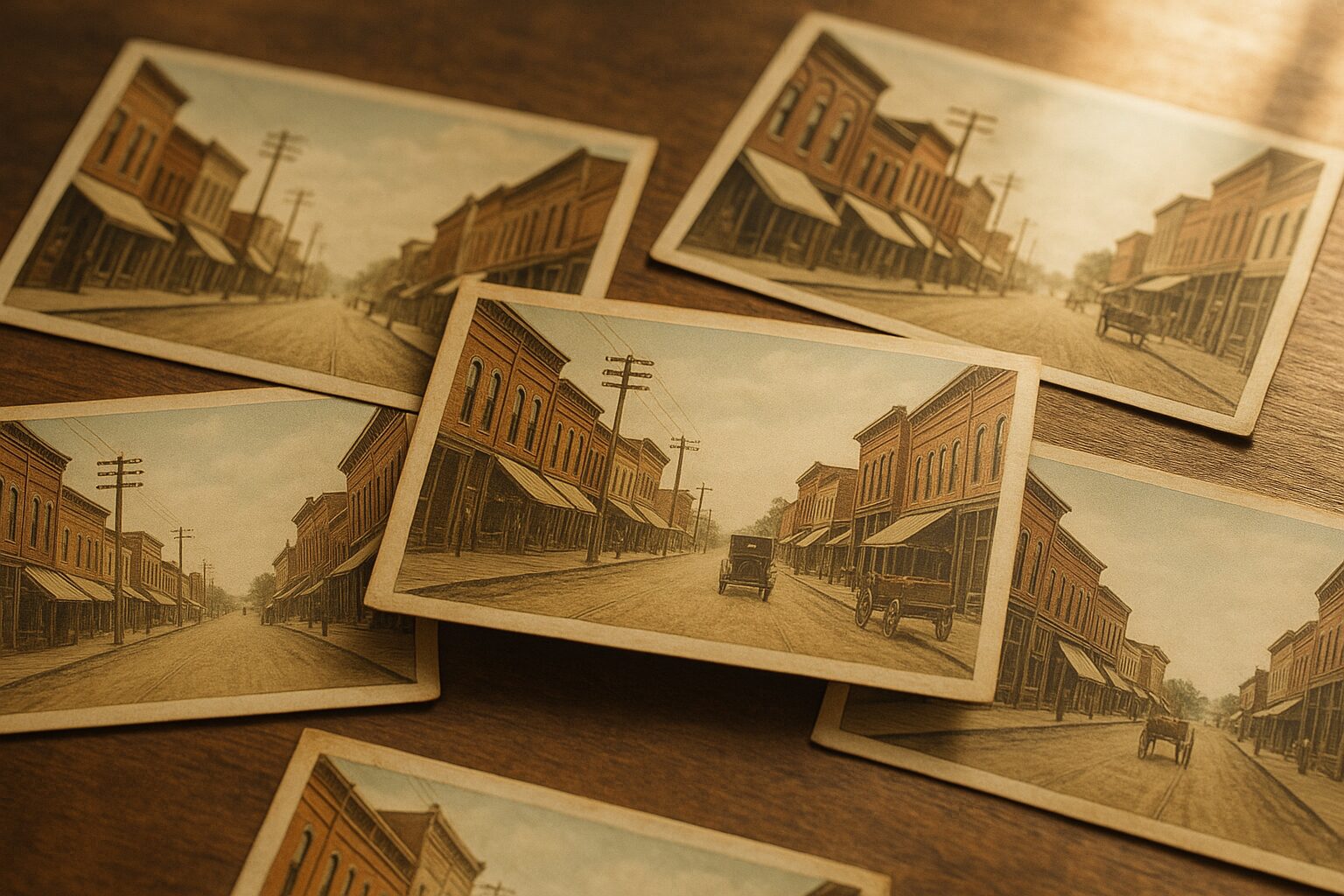
The short version: town view postcards are wanted by collectors who focus on one state, one county or one town, and by local historians and family researchers. The smaller the place, the fewer cards were made, so a view of a crossroads village often outsells a view of a big city. Real photo views are worth more than printed ones, and scenes with people, businesses and vehicles are worth more than empty streets.
Why a small town can beat a big city
Think about how the cards were made. A city like Chicago or New York had dozens of publishers printing tens of thousands of cards of the same famous streets and buildings. Those cards survive in enormous numbers today, and there are always more of them than collectors who want them.
A farming town of six hundred people might have had one druggist who ordered a few hundred printed views from a publisher, and one traveling photographer who made real photo cards of main street for a summer. Fewer cards were made, fewer survived, and the people who collect that county or that state are still looking for them. When one turns up, it is often the first time a collector has seen that view.
That is why I always ask where a collection came from. An album put together by a family in one region is often full of cards from towns nearby, and that concentration can be exactly what collectors of that area want.
The views collectors want most
- Main street with life in it. Shoppers, wagons, early cars, a band, a parade, people on the porch of the hotel. A busy street beats an empty one every time.
- Depots. Railroad stations, especially with a train at the platform or people waiting, are some of the most wanted town views of all.
- Businesses you can name. Storefronts with readable signs: the hardware store, the opera house, the bank, the newspaper office, the creamery.
- Public buildings in small places. Schools, churches, courthouses, post offices and libraries in towns that no longer have them.
- Bird's-eye views. Photographs taken from a water tower or church steeple showing the whole town.
- Disasters and change. The fire that took the block, the flood, the new bridge going up, the paving of main street.
Big-city skylines, state capitols, famous hotels and national landmarks are welcome too. They are simply the most common cards, so they count at a lower rate in a quote.
Printed views versus real photo views
Most town views from 1905 to 1915 were printed, often in color, and many of the finest were printed in Germany before World War I. Printed views are still collected and still count. Real photo views of the same places are usually scarcer and are the ones that move a quote the most. The RPPC page explains how to tell them apart in a few seconds.
Sources and further reading
Reading a town view
What I look at on a town view
These four details decide most of what a town view is worth to a collector.
Size of place
How small is the town?
Fewer people, fewer cards made. Villages, hamlets and railroad stops are often the scarce ones.
The scene
Is the street alive?
People, horses, cars, signs you can read. An empty street is the common version of the same view.
The photo
Real photo or printed?
Both count. Real photo views are usually scarcer and carry more of the value in a lot.
The back
Does the postmark help?
A clear postmark from a small or long-closed post office can add interest, even on a common view.
State and county collecting
Many of the most serious postcard collectors in the country collect by geography. Some want every town in their home state. Others focus on a single county, building a picture of how it looked a century ago one card at a time. Historical societies and libraries collect the same way for their archives.
That is good news for anyone selling a collection of town views, because there is a natural buyer for almost every place. A card of a town that shrank to a few houses can mean a great deal to the person who has been looking for it for years.
Geography also explains why two collections of the same size can be valued very differently. A thousand printed views of big tourist destinations are common no matter where you are. A thousand cards of small towns across rural Iowa, Pennsylvania or Kansas, with real photo views mixed in, can be a different thing entirely.
When you describe the collection, the most useful thing you can tell me is which states or regions show up most. You do not need town names. "Mostly Ohio and Indiana" or "lots of New England" is plenty, and the photos will do the rest.
It also helps to mention whether the cards look like they were bought new and kept clean, or mailed and saved by the people who received them. Both are fine. Mailed cards often carry postmarks from small post offices that collectors of that area look for, while clean unused cards tend to show the picture at its best.
Collectors sometimes call these "small town views" or "main street views", and many keep their cards filed by state and town in long boxes.
Albums of travels and hometowns
Many town view collections were built by one person over years: a traveling salesman who mailed a card home from every stop, a schoolteacher who collected her state county by county, a family who saved every card sent to the farm. The messages on the back are part of the history, and I never consider writing a fault.
You do not need to identify the towns. Photograph a few album pages flat in daylight, and if the cards are loose, spread out a handful and photograph a few backs too. I will recognize most places from the captions and postmarks.
Please send the collection complete. My quote is for the whole collection as you describe it, including the views of your own hometown, and a collection kept intact is the one collectors value most.
And if the collection includes cards of places that no longer exist, such as towns flooded by reservoirs, mining camps that emptied out, or rail stops that disappeared with the line, those are among the views collectors prize most. You do not need to know that about a card. I will recognize many of them, and the ones I do not, I enjoy looking up.
You never pay to ship, and you never sell at a price you didn't agree to
Once you accept the quote, I email a prepaid, insured shipping label. When the postcards arrive I go through them and pay you within two business days.
If what arrives is different from the photos and my offer has to change, you can say no, and I ship everything back to you at my expense.
- PayPal
- Check by mail
- Zelle
- Venmo
Frequently asked questions
- What kinds of old postcards do you buy?
- Real photo postcards above all, especially small-town streets, storefronts, occupations and transportation. Also town views, embossed holiday cards (Halloween especially), topicals such as railroads, early cars, advertising, disasters and expositions, and whole inherited or estate collections. See what I buy.
- Are postcards with writing on the back worth less?
- Generally no. Most collectors are happy with used cards, and a message or a clear postmark can add interest. What lowers value is damage to the front: creases, tears, stains, tape or glue.
- What if I have no idea what I have?
- That's a very common situation, and it's fine. Describe what you can see in plain words (albums or boxes, roughly how many, black and white photographs or colored prints) and add a few photos. I'll tell you what it is.
- Do you buy small lots or single cards?
- My focus is collections and large lots, but a smaller group of good real photo postcards, early holiday cards or strong topicals is welcome. A handful of common printed views usually isn't worth shipping, and I'll tell you so honestly.
- What if the collection is not what I described?
- It happens, usually because damage wasn't visible in photos or part of the collection was left out. If that changes my offer, I explain why by email with a revised number. You can accept it, or decline and have everything returned free.
A question first?
Something here you want to ask about?
Send a question about a card, an album or a whole estate. You don't need to be ready to sell to ask.