What makes a disaster postcard valuable: fires, floods, and storms
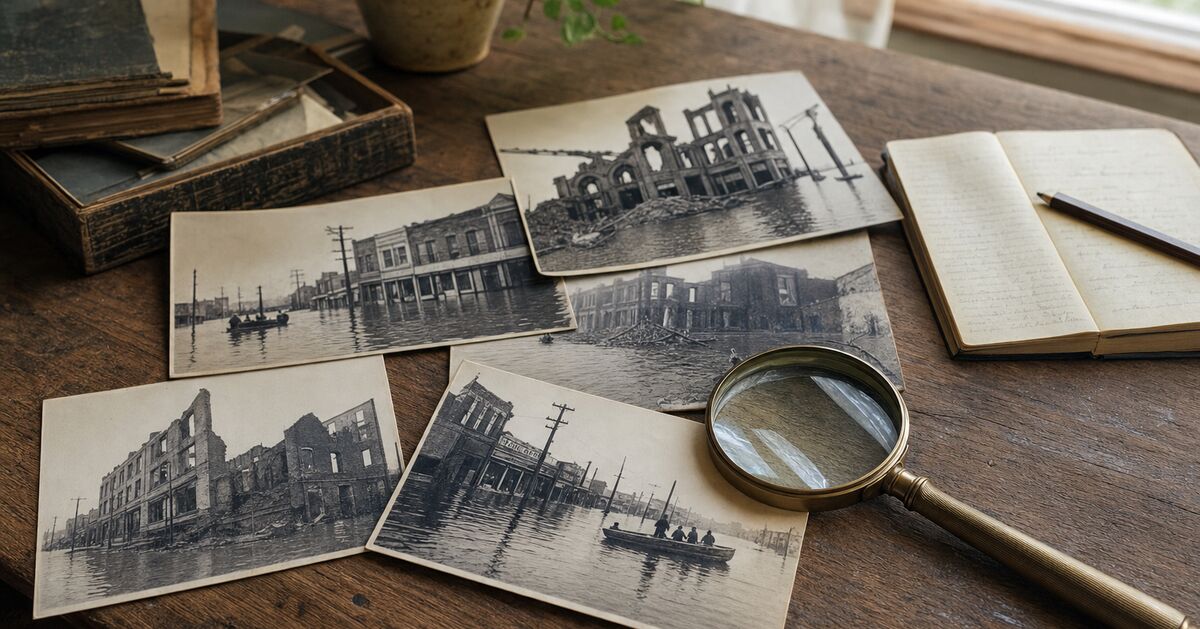
Disaster postcards are among the most historically charged images in any collection, and they can range from almost nothing to genuinely serious money depending on a handful of very specific factors. A generic flood view printed by a major publisher and sold in the millions might bring two or three dollars. A real photo postcard showing the smoldering ruins of a courthouse the morning after a town fire, postmarked the same week, can fetch well over a hundred - sometimes far more. The difference comes down to photography type, local specificity, timing, condition, and what the card actually shows. Let me walk through all of it.
Why did people send disaster postcards in the first place?
It sounds strange today, but mailing a postcard of a catastrophe was completely normal in the early 1900s. The postcard was the text message of its era - fast, cheap, and visual. When a flood hit a river town in 1907, local photographers were on the scene within hours. By the next day, prints were being made and sold. Within a week, cards were in the mail headed to relatives across the country. The message on the back often read something like "This is our street - we are all safe." Disaster cards were a way of saying "I witnessed this" and also of sharing news before radio and television existed.
That context matters for valuing cards. The history of the American postcard is really a history of how people communicated in real time, and disaster cards are some of the most vivid examples of that communication. Cards produced immediately after an event - before national publishers got around to issuing sanitized lithographed versions - tend to be far scarcer and far more desirable.
What types of disasters show up most on early postcards?
The range is wide. Here are the categories that appear often enough to have active collector followings:
- Fires - courthouse fires, hotel fires, downtown business district fires, mill and factory fires, and the catastrophic urban conflagrations like the 1906 San Francisco earthquake and fire or the 1871 Chicago fire aftermath cards
- Floods - river towns were hit repeatedly; the 1913 Ohio River flood, the 1927 Mississippi River flood, and countless local events generated enormous numbers of cards
- Tornadoes and windstorms - Midwest tornado damage cards are plentiful but vary wildly in specificity and rarity
- Earthquakes - the 1906 San Francisco series is the most collected; other western events also appear
- Hurricanes and coastal storms - Gulf Coast and Atlantic coast events, including the catastrophic 1900 Galveston hurricane
- Mine disasters and industrial accidents - less common but intensely collected, especially by occupational postcard collectors (see the guide to occupational postcards)
- Train wrecks - occasionally overlap with railroad postcard collecting
- Blizzards and ice storms - more common as novelty images than as disaster records, but genuine storm-damage cards exist
My guide to disaster postcards covers the broader landscape of the category. Here, I want to focus specifically on what separates a high-value example from an ordinary one.
Is the card a real photo, a linen, or a printed view?
This single question does more to set the price floor and ceiling than almost anything else.
Real photo postcards (RPPCs) are photographs printed directly onto postcard-stock paper. You can usually identify one by a smooth, continuous-tone image with no visible dot screen when you look at it under a loupe. The back will carry a photo paper brand name - AZO, VELOX, KRUXO, CYKO, and others - stamped into the paper stock. These were made one at a time or in small batches, often by local photographers. For a disaster card, that means the image is almost certainly of the specific event, the specific town, and often the specific street or building. Rarity is built in. Real photo cards of the 1913 Dayton flood showing named streets or identifiable buildings tend to sell for noticeably more than generic views, based on recent completed auction sales.
Printed cards from major publishers - including linen-era cards from Curt Teich and similar printers - were produced in runs of thousands or tens of thousands. Disaster images were sometimes produced this way when the event was large enough to warrant a national print run. The 1906 San Francisco earthquake generated many printed card designs, and a large share of them remain easy to find today. Value on these tends to be lower unless the specific image is unusual or the card has significant postal history on the back. The linen postcards guide explains how to read those cards and what makes some scarce.
Divided-back and undivided-back printed cards from the 1900s to early 1910s can split the difference. A divided-back card from a regional printer covering a local fire in a small town likely had a small print run, often just a few hundred copies. That's a different animal from a nationally distributed view. The divided back postcards guide can help you date the card's era from the back layout alone.
The hierarchy for disaster cards, roughly: real photo first, then regional printed cards with small print runs, then nationally distributed printed views.
Does location matter - and how much?
Location matters enormously. A card showing flood damage on a generic "Main Street" with no identifying signage and no named town is difficult to place and difficult to sell at a premium. A card with a legible street sign, a named business, or an identifiable building - especially in a small town - is a different proposition entirely.
Small-town specificity is a consistent driver of value in topographical postcard collecting generally. Collectors who focus on a particular county, state, or town are willing to pay premiums for images they've never seen before from their area. A disaster card of a flood on a major city's waterfront competes with dozens of other known examples. A disaster card of a flood wiping out the only grain elevator in a village of 400 people in rural Kansas may be the only photographic record of that event, and a collector of that county will pay accordingly.
State-specific collectors are a real and active market. Browse postcards by state to get a sense of how geographically organized postcard collecting tends to be. When you're looking at a disaster card and trying to understand its ceiling, ask: how many people collect this specific place, and how many examples of this specific event are known to exist?
What does the postmark tell you?
A used card with a postmark dated within days or weeks of the actual disaster is dramatically more appealing to serious collectors than the same card mailed years later or never mailed at all. The postmark anchors the card in the moment. It confirms the card was circulating when the ruins were still smoking or the water was still receding. That's a layer of historical authenticity that no unstamped card can replicate.
The message on the back adds another layer. A card where the sender writes "We lost the barn and the chicken house but the house stood" is a primary historical document, not just a postcard. Handwritten witness accounts on disaster cards turn up occasionally, and they significantly increase both collector appeal and historical value. The guide on used vs. unused postcards goes deeper on how postal history affects value across the board.
What specific features push a disaster card's value up?
Beyond card type and location, here are the image-level details that collectors pay attention to:
- People in the image - bystanders, rescue workers, or victims visible in the scene add human scale and interest; a fire card showing firefighters working a hose line is more compelling than empty ruins
- Named businesses or identifiable signage - lettering on storefronts, bank signs, hotel names; these help place the image and attract collectors of that specific business or building type
- Unusual damage or spectacle - a building half-collapsed in a photogenic and dramatic way; flood water at second-story window level; tornado debris fields
- Before-and-after pairs - a card showing the same street before the disaster (often a standard Main Street view) paired with the aftermath is a find; pairs sell together for more than the sum of parts
- Identified photographers - some local photographers who documented disasters are known by name, and their work carries a premium; check the image area and back for any photographer credit
- Unusual card format - oversized cards, hold-to-light cards (though rare for disasters), or cards with inset images all add visual interest
- Series cards - some disasters were documented in numbered series of 6, 10, or 12 views; a complete or near-complete series is worth considerably more than single cards
How does condition affect disaster postcard value?
Condition matters for disaster cards the same way it does for every other category, but there's one nuance worth understanding: many disaster cards were used and mailed, and a postmark or handwritten message that documents the event can offset condition issues that would otherwise reduce value significantly. A Very Good card with a postmark from three days after the flood is a better sale than a Near Mint card with no postal history.
That said, significant physical damage - heavy creasing, corner tears, writing across the image face, album mount damage, or fading that obscures the scene - will reduce value on any card. The postcard condition guide explains the standard grading terms and what each grade actually means in practice.
What makes the 1906 San Francisco earthquake cards so heavily collected?
The 1906 San Francisco earthquake and fire is the single most documented disaster in American postcard history. Dozens of photographers were working the scene within hours. Publishers including Detroit Publishing Company produced view series within weeks. The event was catastrophic enough - and the city prominent enough - that national audiences wanted images. The result is a large and well-studied body of material.
Collectors of this event break it down by neighborhood, by photographer, by publisher, and by specific building or street. Common wide-view 1906 earthquake scenes tend to sell cheaply, often in the single digits to low tens of dollars. Real photo cards of known buildings or unusual vantage points can command much higher prices than common printed views. A real photo postcard with a message written in the days immediately after the earthquake, mailed from the city, is a serious piece of historical documentation and prices reflect that.
The Detroit Publishing Company postcards guide covers one of the major publishers active during that era and explains how to read their marks and assess scarcity.
Are there disaster postcard categories that are undervalued right now?
This is harder to call with certainty, but a few categories seem to attract less competitive bidding than their historical significance might suggest. Mine disasters from the early 1900s are one area - the overlap between disaster collecting and occupational collecting means neither group has fully claimed them, and prices can be lower than you'd expect for genuinely rare real photo images. Blizzard and ice storm cards from rural areas are another - dramatic ice-coated farm scenes or buried roads are visually striking and often locally rare, but they sit outside the "fires and floods" collector mainstream.
Industrial accident cards - factory explosions, gas works fires, bridge collapses - occasionally surface and tend to be scarce because the events were local and the print runs were tiny. These are worth a closer look if they appear in a collection.
How do I figure out what a specific disaster card is worth?
The practical answer is to search completed sales on eBay for the specific event, the specific town, and the card type. Completed sales - not active listings - show what buyers actually paid. A real photo flood card from a named small town may have one or two comparable sales in the last year; a generic printed tornado card may have dozens. That spread tells you something about both the demand and the scarcity.
The postcard price guide explains the methodology for researching values across categories, and the guide on real photo postcard value goes deep on the RPPC premium specifically. If you're looking at a collection that includes disaster cards and want to understand what the overall group might be worth, the postcard appraisal page explains your options.
If you have a collection that includes disaster cards - or a collection built entirely around disaster views - I'm always interested in taking a look. The sell page is where you can describe what you have and get a sense of whether it's something I'd want to acquire as a whole collection.
Questions people ask
Are disaster postcards considered morbid, or do people actually collect them?
Disaster postcards have been actively collected since the early postcard era itself - the people who first bought them were eyewitnesses and curious members of the public, not morbid curiosity-seekers in any unusual sense. Today, collectors are drawn to them for historical, genealogical, and topographical reasons. They document events that might otherwise have no visual record at all.
Do I need to know the exact event to sell a disaster postcard?
Not necessarily. A real photo card with clear damage imagery and a legible location (even a partial street name or visible storefronts) is identifiable enough for a knowledgeable buyer to research and value. That said, a card where the location and event are completely anonymous is harder to sell at a premium - the historical specificity is part of what collectors are paying for.
What's the difference between a disaster postcard and a souvenir view of a disaster?
The distinction is timing and intent. A card made and mailed within days or weeks of the event, often by a local photographer, is a disaster postcard in the truest sense - it was made to document and communicate. A card produced months or years later as a retrospective souvenir of a famous event (the 1906 earthquake is full of these) is historically interesting but less rare and less charged as a document. Collectors value the contemporaneous card more.
How do I tell if a disaster card is a real photo versus a printed reproduction?
Look at the image under a loupe or strong magnifying glass. A real photo postcard will show continuous tones with no dot screen pattern - smooth gradients like a photograph. A printed card will show a visible halftone dot pattern under magnification, similar to a newspaper photograph. The back of a real photo card will also carry a photo paper brand name stamped into the stock. The guide to postcard condition and grading includes tips on examining card surfaces closely.
About this guide
- Research: Mike Ferreira
- Last reviewed: October 30, 2026
- Claim audit: 5 consequential claims checked against the sources below on Oct 30, 2026; wording the sources could not carry was removed (claim-by-claim)
- Spotted an error? Tell me and I will fix it.
Revision history (1)
- Oct 30, 2026 - Pre-publish editorial QA: clean; claim audit: 5 claims, 5 rewritten
A question first?
Ask before you send anything
Not sure the collection is worth a quote, or what to photograph? Just ask. Every message comes straight to me, and I answer each one myself.