Holiday postcard sets vs. single cards: how to identify and value them
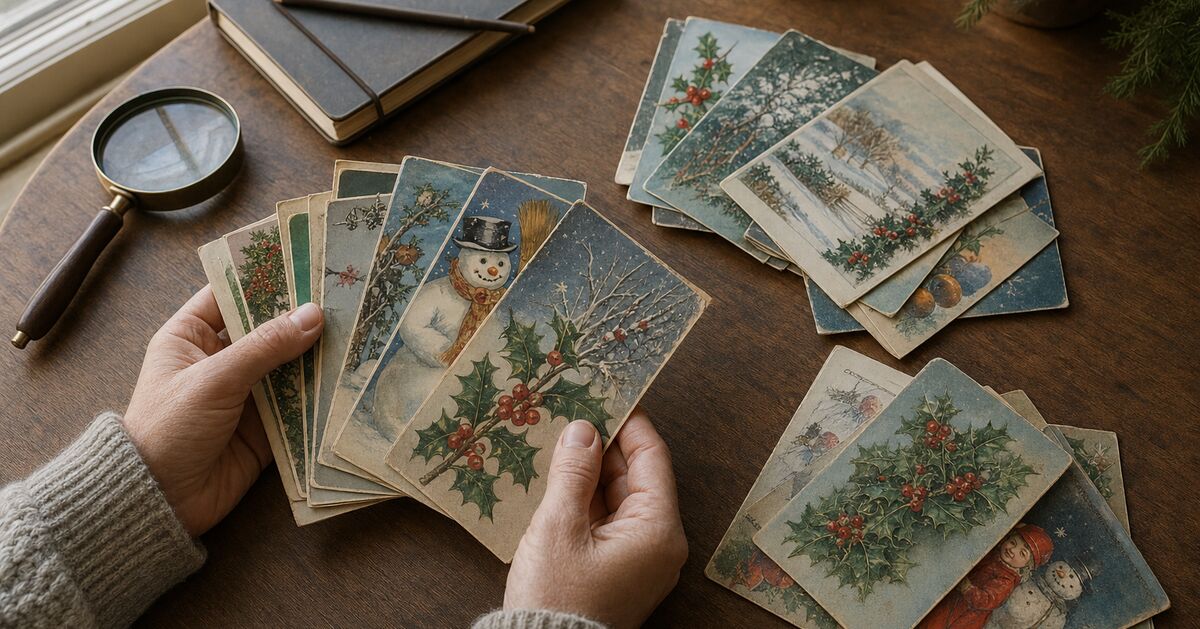
A complete holiday postcard set from the early 1900s is often worth more - sometimes dramatically more - than the same number of loose, random holiday cards added up one by one. The reason is simple: collectors building a series need every card, and rarity is multiplied when completeness is required. If you've got a stack of old Christmas, Easter, or New Year's cards and you're trying to figure out what you have before you sell, understanding the difference between a cohesive publisher's set and a miscellaneous assortment is one of the most useful things you can do.
What exactly is a holiday postcard set?
A postcard "set" is a group of cards that a publisher intentionally designed, numbered, and sold together as a unit. During the golden age of postcards - roughly 1900 to 1920 - publishers like Raphael Tuck & Sons, John Winsch, and Ellen Clapsaddle's publisher (International Art Publishing Co.) produced structured series with consistent artwork, uniform borders, matching backs, and sequential series numbers. A Christmas set might run six cards, all depicting the same artist's rendition of Santa Claus in different scenes, numbered Series 100 through 106 on the back. An Easter set might pair six cards showing children with decorated eggs, all sharing the same ornamental border and the same series designation.
These sets were sold in envelope packets in stationery shops, or mailed individually by senders who collected the whole run. That origin matters for valuation because it means the collector market is built around completeness. Someone who owns five of six cards in a desirable Winsch Christmas series has strong motivation to pay a premium for that sixth card - and to pay fair market value for the set if they find it intact.
This is very different from a "lot" of holiday cards - say, forty miscellaneous Christmas cards from the 1900s through 1930s, mixing publishers, formats, conditions, and subjects. Those have value too, but it's the aggregate value of individual cards, not a set premium. The guide to antique Christmas postcards goes deeper on which holiday themes collectors prize most, and it's worth reading alongside this one.
How do I recognize a publisher's set in a collection?
Look at the backs first. Flip every holiday card over and check for three things:
- A series number or set number - This is the clearest sign of a structured set. It might read "Series 501," "No. 123," or simply a printed number in the stamp box or along a border. The number will repeat across the cards in the same run.
- A publisher's imprint - Raphael Tuck, John Winsch, International Art, Paul Finkenrath of Berlin (PFB), and others printed their names and sometimes their country of origin on the back. Cards from the same publisher sharing the same series number almost certainly belong together.
- Back style consistency - The layout of the divided back, the font used for "Post Card," the position of the stamp box, the color of the printing, and the presence or absence of a patent line will all match across cards in a genuine set. If four Easter cards share identical backs and a fifth has a different layout entirely, that fifth card likely comes from a different publisher or a different series, even if the artwork looks similar.
The front is secondary evidence. Within a true set, the artwork style is consistent - same artist hand, same border treatment, same color palette. Subject matter follows a theme: all Santas, all bunnies, all turkeys, all greetings of a particular type. Cards that drift in subject or style within a supposed "set" are probably a dealer's assembled lot rather than an original publisher series.
The postcard glossary has clear definitions of terms like "series," "set," and "publisher number" if any of this terminology is new to you.
Does completeness really change the price that much?
Yes - and often by a wider margin than expected. Here's the underlying logic:
A popular Winsch Christmas series in Very Good condition tends to see individual card values that vary widely depending on the specific image. Six cards at those prices gives you a rough aggregate of perhaps $80 to $180. But a confirmed complete set of those same six cards, known to be intact, can command a substantial premium from a collector who wants the whole run. The premium exists because:
- The collector doesn't have to source the remaining cards one at a time, paying shipping multiple times and risking condition mismatches.
- A complete set has display and exhibit value that a partial run doesn't.
- Completeness is relatively rare - sets got split up at every stage of their lives, from the original rack sale through every estate and dealer table since.
That said, the premium is not unlimited. A set only carries a meaningful premium if the series itself is desirable. A complete run of six common, low-demand 1950s chrome Christmas cards from a minor publisher might carry almost no set premium at all, because the collector audience is thin and the cards are easy to find individually. The premium is sharpest for sets from the golden age (1900 to 1920), by named artists, from known publishers, in sought-after holiday categories.
Vintage Halloween postcards represent an extreme version of this: a complete set of Halloween cards by a recognized publisher in that era can be worth multiples of what the individual cards would bring, because Halloween postcard collectors are passionate, the category is small, and sets rarely survive intact.
How do I figure out if a set is complete?
This is the tricky part, because you need to know how many cards the original series contained. A few approaches work:
Check the series numbering. If the cards are numbered sequentially - say, No. 1 through No. 6 within a series - and you have all six, that's strong evidence of completeness. If you have No. 1, 2, 4, and 6, you're obviously missing two.
Reference published checklists. The hobby has produced detailed checklists for major publishers. The Postcard Collector's Handbook, Lois Sherbow's work on John Winsch, and specialized society publications from the Deltiologists of America and similar groups document set sizes for many common holiday series. University library collections sometimes hold these references. The postcard shows and dealers page points toward the collector community where this knowledge lives.
Compare against auction records. Completed sales on established postcard auction platforms often describe set sizes. Searching for the specific series number alongside the publisher name in completed listings will usually surface either sold sets (telling you the set size) or individual cards described as "one of six" or similar.
Ask within collector forums. The postcard collector community is generous with reference knowledge. Sharing a scan of the back with the series number visible will often yield an answer about set size within a day.
One important caution: resist the temptation to assume a set is complete just because the cards look like they go together. Many collections were assembled by earlier owners who pulled thematically similar cards from different sources. What looks like a set might be four cards from Series 100 and two from Series 200 by the same publisher - related, but not a true matched set.
What holiday categories carry the strongest set premiums?
Not all holidays are equal in the postcard market. Here's how the main categories tend to stack up, based on collector demand:
Christmas carries consistent demand year-round, not just in December. Santa Claus subjects are the strongest performers, especially sets showing Santa in pre-Coca-Cola red-suit depictions, or in European-style bishop robes. Sets by Raphael Tuck (you can read more about their output at the Raphael Tuck postcards page) carry a recognized collector premium. Nativity-themed sets are thinner in demand.
Halloween is the highest-energy category. Demand is intense and the supply of complete sets is limited. A complete series of six or eight Halloween cards by a reputable publisher is a genuinely rare find.
Easter has a loyal collector base, especially for sets featuring dressed-up chicks, bunnies in human clothing, or children with large decorated eggs. Artist-signed Easter sets command the most attention.
Thanksgiving is a step below Christmas and Easter in demand, but sets featuring anthropomorphized turkeys or Pilgrim scenes have a following. Sets by artist Ellen Clapsaddle are often mentioned as being in demand.
New Year's cards, especially those featuring clocks, top hats, pigs (a European luck symbol), and champagne, attract a secondary collector market. German-printed New Year's sets often show high production quality; the guide to German-printed postcards explains why that matters.
Valentine's Day holiday sets can be strong, especially mechanical or novelty sets, though the market is more fragmented.
What if the collection mixes sets and loose cards together?
This is the normal situation. Very few inherited collections are purely sets - most are a mix of intact series, partial runs, and completely miscellaneous cards that ended up together by accident of collecting history. That's fine. What matters is that you document what you have accurately before you describe the collection to anyone.
Go through the holiday cards specifically and group by publisher and series number. Note which groups are sequential and appear complete, which are partial, and which cards are clearly one-offs. Write it down. You don't need to become an expert - you just need to be able to describe what you see on the backs: "I have about 40 Christmas cards, and about 12 of them have matching Raphael Tuck backs all showing 'Series 123' and seem to go together. The rest are mixed."
That level of description is genuinely useful when you're deciding how to sell. If you're exploring what your overall collection might be worth, the postcard price guide gives good context for how individual card values are established, and the guide to real photo postcard values is worth checking if any of the holiday cards are actual photographs rather than lithographs.
Does condition matter differently for sets than for individual cards?
It matters more. With a single card, a minor flaw is a minor flaw - it lowers the value of that one card and you move on. Within a set, condition consistency across all cards matters, because a buyer is essentially grading the set as a unit. A set of six cards where five are in Fine condition and one is in Poor condition creates a problem: the weak card drags the presentation of the whole set down, and a collector may value it only slightly above the five good cards rather than paying the full set premium.
The reverse is also true: a set where every card has survived in Excellent or better condition is rare enough that it can command a premium above even the standard "complete set" price. The postcard condition guide lays out the standard grading terms clearly, and it's worth using that language when describing what you have.
Cards that have been written on, postmarked, or used carry their own nuances. For holiday sets, unused cards are generally preferred by collectors building display sets, but a used set isn't disqualified - it just carries a modest discount compared to a matching unused run. The used vs. unused postcards guide covers this trade-off in detail.
Should I keep a set together or sell it as individual cards?
Keep it together. Always. This is true for sets specifically and for the broader collection generally. Splitting a set - even with the intention of getting top dollar for each card individually - typically results in lower total value, more effort, more time, and the destruction of whatever set premium exists. A buyer who wants the full set isn't going to pay full-set price for a partial run; they'll pay individual-card prices for whatever you have left.
The same logic applies to the broader collection. If you're thinking through your options, the guide at how to sell old postcards explains the full picture clearly. And if you're wondering what to actually do with a collection you've inherited or discovered, what to do with old postcards is a good starting place.
Questions people ask
How can I tell if a holiday postcard is part of a named artist's set?
Check the back for a publisher imprint and series number, then check the front for a signature or monogram. Artists like Ellen Clapsaddle often signed their work in the lower corner of the image. If you find a signature, search the artist's name alongside the publisher and series number to identify the specific series. The guide to artist-signed postcards explains how artist attribution affects value.
Are partial holiday sets worth much compared to complete ones?
A partial set is generally valued as a group of individual cards rather than as a set. You won't typically get the set premium if even one card is missing, because the collector who wants the set still has to source the remaining card(s) elsewhere. That said, partial sets from desirable publishers or artists still have solid individual-card value.
Does it matter what holiday the set covers when figuring out value?
Yes, significantly. Halloween and Christmas sets from the golden age (1900 to 1920) consistently attract the strongest buyer demand. Easter and Thanksgiving follow. The holiday category affects both how many collectors are competing for a card and how urgently they want to complete their runs.
What's the best way to describe a holiday set when selling a collection?
Note the publisher name, the series number printed on the back, the number of cards you have, whether the set appears complete, the holiday subject, and the general condition. A description like "Complete Raphael Tuck Christmas Series 500, 6 cards, artist-signed, light postal use on two cards, Fine to Very Fine overall" gives a buyer everything they need to evaluate what you have without you needing to appraise it yourself. If you'd like to describe a collection and get a sense of what it's worth, the sell page is the place to do that.
About this guide
- Research: Mike Ferreira
- Last reviewed: November 9, 2026
- Spotted an error? Tell me and I will fix it.
Sources & further reading
- Getty Research Institute - ephemera and printed graphics collections (Getty Research Institute)
A question first?
Ask before you send anything
Not sure the collection is worth a quote, or what to photograph? Just ask. Every message comes straight to me, and I answer each one myself.