Antique Halloween postcards 1905-1915: what collectors look for
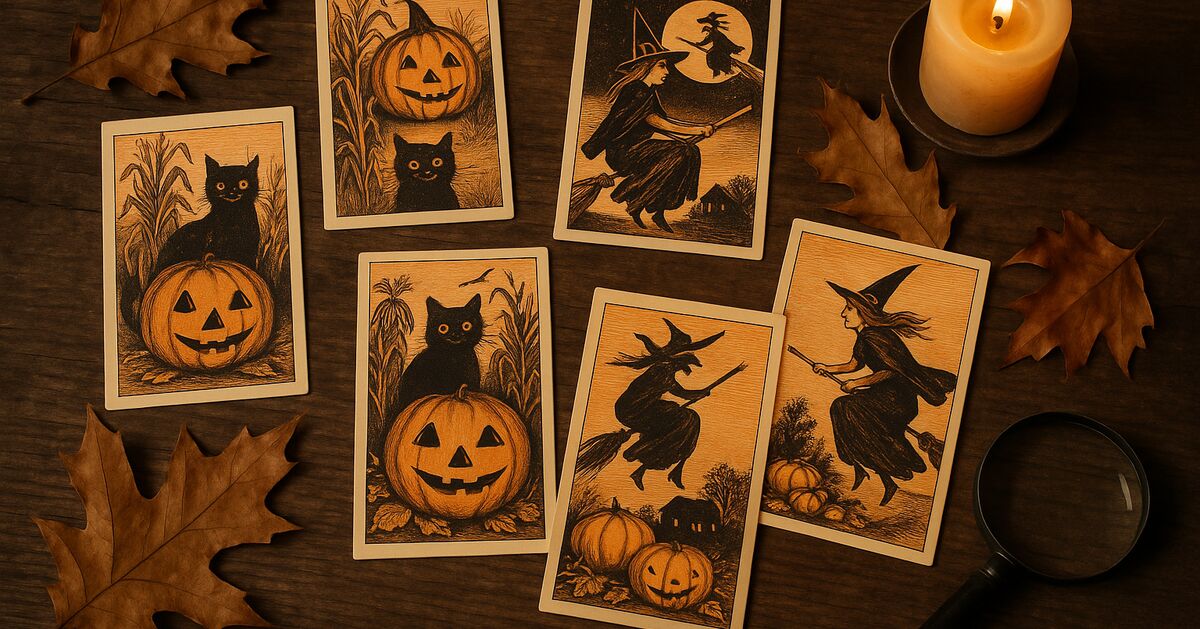
Collectors report that Halloween postcards printed in Germany around 1909 can sell for hundreds of dollars, with rare artist-signed examples in pristine condition often selling for more. That is not hype; that is what happens when a narrow ten-year window of printing technology, an explosion of postal culture, and one of America's most image-rich holidays collide at exactly the right moment in history.
For the complete reference, see my guide to vintage Halloween postcards.
If you are new to the category, welcome to one of the most visually exciting corners of the postcard hobby. If you are already hunting, this guide digs into the specific details that separate a $12 card from a $250 card - and why those differences matter.
Why the years 1905 to 1915 matter so much
The decade bracketed by roughly 1905 and 1915 sits inside what collectors call the Golden Age of postcards. During this period, lower postage rates and improved printing technology led many Americans to mail postcards frequently, similar to how people later used text messages. Publishers ordered enormous print runs of seasonal greetings, and Halloween - already well established as a community holiday by the early 1900s - gave illustrators a rich playground of witches, goblins, black cats, jack-o'-lanterns, harvest moons, and fortune-telling imagery.
The timing also coincided with the peak of chromolithographic printing in Germany, where most American-market postcards were produced before World War I interrupted the trade. German presses could lay down six, eight, sometimes twelve colors in exquisite registration on a small card-sized sheet. That technical quality is exactly what collectors can still see and feel a century later. After German printing was disrupted by the war around 1914-1915, American printers took over production but are generally considered to have produced less vivid color and line quality. That transition is part of why the pre-war cards command a premium.
For a broader sense of how the postcard hobby works and what makes any category collectible, the home page is a good starting point, and the frequently asked questions page covers the basics of grading, dating, and buying.
Publishers and their marks - why they matter
Not all Halloween postcards from this era are equal, and the publisher printed on the card's back (the "publisher's mark" or "backstamp") is one of the first things experienced collectors check.
John Winsch is the name that commands the most consistent attention in Halloween collecting. Winsch was a New York publisher who contracted some of the finest German printers and employed talented artists. His Halloween cards typically feature bright orange and black coloring, elaborate embossed borders, and figures that have a lively, almost theatrical quality. Winsch cards are signed on the back with the company name and often a copyright date, which makes dating straightforward.
Ellen Clapsaddle is among the most recognized artist names in holiday postcard collecting generally, and her Halloween output for the International Art Publishing Company is particularly prized. Clapsaddle's children are rosy-cheeked and slightly stylized, her pumpkins glow with an inner warmth, and her compositions have a balance that reads well even at postcard scale. Cards signed "Ellen Clapsaddle" or marked with her initials carry a meaningful premium over unsigned cards from the same publisher.
Raphael Tuck & Sons, the British publisher with American distribution, produced Halloween series that tend toward richer, more saturated backgrounds and slightly more dramatic figure work. Tuck cards are usually marked on the back with the company name and a series number, which helps collectors track down complete sets - a goal that drives real competition.
Nash, Bergman, and Samuel Schmucker (whose stylized, almost Art Nouveau figures are unmistakable) round out the names that come up again and again in serious collections. Schmucker cards in particular show up on the blog discussions about crossover collecting, because his work attracts both Halloween specialists and Art Nouveau enthusiasts bidding against each other.
If the back of a card has no publisher mark at all, that is not automatically a bad sign - some genuine early cards were printed without them - but it does remove one verification layer, which affects what a careful buyer is willing to pay.
Imagery and subject matter - what collectors actually want
Within the Golden Age Halloween category, certain subjects outperform others consistently at auction and in dealer inventories.
Anthropomorphized vegetables and fruits - pumpkins and jack-o'-lanterns with human faces, dancing vegetable men, grinning moon faces - are perennial favorites. The stranger and more inventive the composition, the more interest it tends to generate.
Witches in flight are enormously popular, particularly when the witch is a central, large figure rather than a small accent in the background. Silhouette-style witches against a full moon are a classic composition that collectors recognize immediately.
Black cats as primary subjects (not just decorative accents) drive collector interest, especially when the cat is posed dramatically or integrated into a fortune-telling scene. Fortune-telling imagery reflects a Halloween tradition of the era and adds cultural depth that appeals to collectors interested in social history.
Children in costume appeared frequently on Clapsaddle and Winsch cards. These tend to appeal to a dual audience: Halloween collectors and children's illustration collectors, which can push prices higher than subject alone would suggest.
Purely agricultural or harvest scenes without strong Halloween-specific imagery (a simple cornucopia, for example) sit at the lower end of collector interest even when they are technically Halloween-dated cards. The holiday-specific iconography is what many buyers are after.
Embossing, die-cutting, and mechanical cards
Embossing - a raised, three-dimensional surface texture pressed into the card stock - is an almost universal feature of the finest German-printed Halloween cards. Run your fingertip across the surface of a Winsch or Tuck card in good condition and you can feel the jack-o'-lantern or the witch's hat standing slightly proud of the background. That tactile quality was a selling point in 1909 and it remains a quality signal today.
Die-cut cards - where the card is cut to a non-rectangular shape, following the outline of a figure or object - are rarer and correspondingly more desirable. A die-cut black cat postcard, trimmed to the cat's silhouette with a small tab for a stamp and address, is a scarce object. Mechanical cards with movable parts (a pull-tab that changes a face's expression, for example) exist at the very top of the rarity pyramid and are priced accordingly.
Condition grading - the factor that changes everything
A beautiful Halloween card in poor condition is a sad thing and a tough sell. The standard grading language in the postcard hobby runs from Poor through Good, Very Good, Excellent, and Near Mint. For Golden Age Halloween cards specifically, condition problems that come up again and again in collector forums include:
- Creases and folds - cards were mailed, handled, and sometimes tucked into albums with rubber-band bindings that left indentations
- Toning and foxing - small rust-brown spots caused by iron impurities in the paper reacting with humidity over decades
- Album page adhesive stains - the backs of cards removed from old albums sometimes carry a shadow of the adhesive or the album paper itself
- Writing on the image side - some senders wrote on the front when the back was full, which affects the visual integrity of the card considerably
- Faded color - chromolithographic inks are generally stable, but prolonged exposure to light can shift the orange tones toward tan, which dulls the visual impact
Cards graded Excellent or better, with crisp corners, no creases, vivid color, and minimal soiling, typically sell for notably higher prices. That premium is not arbitrary: high-grade Golden Age Halloween cards are not common, because most were mailed and lived in albums for a century. The inherited a postcard album guide covers why that album history matters when you are assessing condition for the first time.
Postally used versus unused - does it matter?
This is a question that divides collectors pleasantly. A card that was actually mailed carries a postmark, a stamp, and handwritten message - all of which add a documentary layer. A postmark that confirms a 1909 or 1911 mailing date is a kind of authentication, and some collectors actively prefer used cards for that historical connection. The message on the back can itself be charming: "Wishing you a jolly Halloween, come to my party Friday" written in faded ink brings back an October evening more than a hundred years ago.
Other collectors prefer unused cards because the image side is more likely to be pristine and the embossing undisturbed. Neither preference is wrong, and neither consistently commands a higher price across the board - it depends on the specific card and the specific buyer.
Real photo Halloween postcards - a different category entirely
A small number of Halloween postcards from this era are actual photographs rather than lithographic illustrations - real photo postcards (RPPCs) showing costumed children, Halloween parties, or jack-o'-lantern displays. These sit in a category of their own. The hand-lettered or rubber-stamped backs of RPPCs, along with the photographic paper surface, distinguish them immediately from printed cards. Because real photo postcards document actual people and celebrations, condition-appropriate examples can sometimes sell for more than fine Winsch cards.
If you are not sure how to tell a real photo postcard from a printed one, the guide to identifying RPPCs walks through the practical tests in detail.
Where fakes and reproductions appear
The value of this category has, predictably, attracted reproductions. The problems collectors report encountering include:
- Modern reprints on thin stock - the card stock of genuine German-printed cards has a specific weight and slight texture; modern reprints feel noticeably lighter and often have a slight sheen
- Digitally reproduced embossing - genuine embossing is a physical deformation of the card stock; a printed simulation of it looks flat under raking light
- Artificially aged cards - tea-staining or UV exposure to simulate toning can fool a casual eye but rarely survives close inspection of the toning pattern, which on genuine cards is irregular and follows the paper grain
If you're unsure, compare the suspect card under a loupe against a confirmed example. The halftone dot pattern (or absence of one, in genuine chromolithography) is one of the most reliable diagnostic tools. Genuine chromolithography has no halftone dots - it uses continuous flat areas of layered ink. If you see a regular dot grid under magnification, the card was printed by a photomechanical process, almost certainly in a later era. The same logic described in the RPPC identification guide about reading printing surfaces applies here.
Building a collection strategically
A common approach among dedicated Halloween collectors is to focus on a single publisher or a single artist rather than collecting broadly. A complete Winsch Halloween set in consistent grade is a coherent, impressive collection that is harder to assemble than it looks, because the rarer cards in any series are scarce. That focus also makes it easier to develop real expertise - you learn quickly what a genuine Winsch emboss feels like, what the ink colors should look like, and when something is off.
Another strategy is to collect by subject regardless of publisher - building, say, a dedicated black cat grouping or a fortune-telling imagery grouping. These thematic collections have strong visual impact and make excellent display pieces.
Cross-category collectors sometimes pair Halloween postcards with related ephemera - trade cards, magazine covers, or candy containers from the same era - to build a broader picture of how Halloween imagery evolved in American commercial culture between 1900 and 1920. That wider context is part of what makes the hobby endlessly interesting.
For anyone just getting started or wondering how the buying and selling side of this world works, the about page explains the perspective behind this site, and the contact page is the right place to share questions or tips from your own collecting experience.
What to expect when you start shopping
Genuine Golden Age Halloween postcards in average used condition from smaller, unsigned publishers often start around $10 to $25 at general postcard shows and online auctions, based on typical market observations. Clapsaddle-signed cards in Very Good or better condition commonly sell in the $30 to $80 range, depending on the image, based on general market trends. Choice Winsch cards with strong embossing and vivid color in Excellent condition often sell in the $75 to $200 range, with especially rare or desirable examples going higher, according to general market observations. Die-cut and mechanical cards from any quality publisher represent a separate, steeper price tier.
None of those figures is a guarantee; the postcard market is informal and price varies with the specific auction, the specific seller, and who else happens to want that card on that day. But they reflect the general landscape that a careful buyer encounters.
The category rewards patience, close looking, and a willingness to handle a lot of cards before buying. That combination of visual pleasure and historical depth is exactly why Halloween postcards from 1905 to 1915 attract some of the most enthusiastic collectors in the hobby.
About this guide
- Research: Mike Ferreira
- Last reviewed: October 19, 2026
- Claim audit: 12 consequential claims checked against the sources below on Oct 15, 2026; wording the sources could not carry was removed (claim-by-claim)
- Spotted an error? Tell me and I will fix it.
Revision history (1)
- Oct 15, 2026 - Pre-publish editorial QA: 1 flagged, 1 softened; claim audit: 12 claims, 9 rewritten
A question first?
Ask before you send anything
Not sure the collection is worth a quote, or what to photograph? Just ask. Every message comes straight to me, and I answer each one myself.