How to tell if an old postcard is a real photo postcard (RPPC)
Real photo postcards turn up in flea markets, estate sales, and online auctions every single week, and the price gap between a genuine RPPC and a printed reproduction can be substantial. Knowing how to tell them apart is not an optional skill - it is the difference between a thrilling find and an expensive mistake.
For the complete reference, see my guide to real photo postcards.
This guide walks you through every reliable test, explains the science behind each one, and flags the traps that catch even experienced collectors off guard.
What actually makes a postcard a "real photo postcard"?
An RPPC is a photograph printed directly on photographic paper that also happens to have a postcard back. That sounds simple, but the implications are enormous. Because the image is a continuous-tone photograph rather than a halftone or lithographic print, it carries a completely different set of visual and physical properties from any commercially printed card.
The process is generally said to have begun after Kodak introduced its No. 3A Folding Pocket Kodak camera in 1903, which used postcard-size film. By roughly 1907, Kodak and Eastman are believed to have sold postcard-back photographic paper directly to amateur photographers and small-town portrait studios. The result was likely many millions of unique or small-edition photographs produced between about 1900 and 1950, with some continuing into the 1960s.
That history matters because it shapes everything you are looking at when you pick one up: the paper chemistry, the back stamp designs, the tonal range, and the reasons a genuine card looks and feels the way it does.
The magnification test - your single most reliable tool
Carry a 10x loupe or a jeweler's loupe to every postcard show. It costs very little and it never lies.
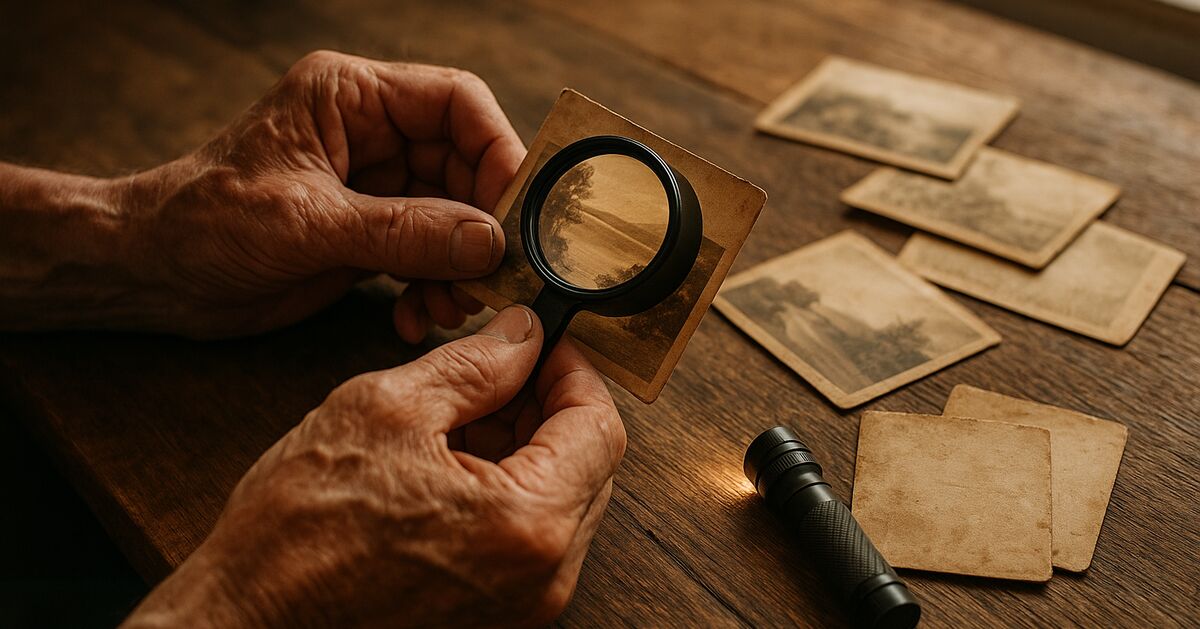
Hold the loupe against the image side of the card and look closely at any mid-tone area - a gray sky, a shaded wall, a woman's dress.
- Printed cards (halftone or offset lithography) break up into a regular grid or rosette pattern of tiny dots. Under 10x magnification those dots are unmistakable, even on high-quality modern reprints.
- Genuine RPPCs show a continuous, grain-like, organic texture. There are no dots. The tonal transitions melt smoothly from light to dark, exactly as a photograph does. You may see silver grain if the emulsion is thin, but it will be random, never organized into a pattern.
This single observation settles the question in most cases. If you see dots, you do not have a real photo postcard - full stop.
The paper and surface feel
Photographic paper has a distinctive feel that printed paper does not quite replicate.
Run your fingertip lightly across the image. Genuine photographic emulsion sits on a resin or gelatin coating that gives the card a faintly glassy, smooth surface - noticeably different from the slightly toothy feel of a lithographed card. On glossy-finish RPPCs (the finish chosen for roughly the 1920s onward), this effect is especially pronounced.
Matte and "velvet" finish RPPCs (common in the 1900s-1910s) are less dramatic to the touch, but the emulsion still has a consistency that differs from ink on paper. With practice, your fingertips learn the difference.
Also check the weight and flexibility. Photographic postcard paper was made to a standard thickness but tends to be slightly denser and less prone to surface scuffing than a printed card of similar age. A reprint on modern inkjet photo paper will feel thinner and more plastic-y; a reprint on glossy offset stock will feel shinier and flimsier.
Reading the postcard back - the AZO, Velox, and Cyko stamp guide
The divided-back side of an RPPC is one of the most powerful dating and authentication tools available, and it is completely free to read.
Photographic paper manufacturers printed their brand name and often a stylized logo directly onto the back of their postcard paper. The most common you will encounter in North American collections are:
- AZO was produced by Kodak from roughly 1904 onward, and collectors say its logo variations can help date a card within a decade. The classic AZO back features four triangles arranged in a square. The direction those triangles point (up or down) changes by era.
- Velox was another Kodak product, reportedly common from about 1907 to 1920, recognizable by its distinctive font.
- Cyko was made by Ansco and is generally found on cards from approximately 1904 to 1920.
- Artura, Defender, Kruxo, Haloid - less common but legitimate photographic paper brands you will occasionally encounter.
If none of these names appear and the card claims to be an old photo, that is worth investigating further. Reprints printed on modern paper will have no paper manufacturer's back stamp, or they will have a modern printer's name.
Some postcard researchers have published AZO stamp dating guides that are referenced in the collector community; searching for "AZO stamp dating" can help you find them.
Postmark and stamp box clues
Check the stamp box in the upper right corner of the back. The shape and labeling of the stamp box changed over the decades. For American cards:
- Undivided back (pre-1907): the back was entirely for the address; any message had to go on the front.
- Divided back (1907 onward): a line divides address from message space.
If a card has a divided back and an AZO stamp consistent with 1907-1918, you are in strong authentic territory. If the stamp box looks modern - or if there is a barcode or inkjet printer mark hiding anywhere - you are looking at a reproduction.
A postmark, when present, is enormously helpful. Ink cancellations on genuine cards often show feathering into the paper fibers under magnification. A postmark that sits perfectly crisp on top of the emulsion without any ink absorption is suspicious.
Image content as an authentication clue
This is not a substitute for the physical tests above, but image content can raise or lower your suspicion before you even get out the loupe.
Genuine RPPCs were typically produced in very small editions - often a single print from a single negative. The subject matter therefore tends to be personal, local, or documentary: family portraits, Main Street storefronts, local disasters, farm scenes, occupational portraits, sports teams. If you see a card with an image that was widely commercially distributed - a famous landmark shot that appears on dozens of printed cards from the same era - be more careful. Reprinters often chose popular images precisely because they sold well.
Conversely, a card showing a Kansas grain elevator, a small-town fire department, or a woman in her Sunday best on a farmhouse porch is exactly the kind of subject that only existed as an RPPC. That context supports authenticity, though it does not replace the magnification test.
Tonal range and image quality
A well-preserved RPPC has a tonal richness - deep blacks, clean whites, and smooth mid-tones - that offset or halftone printing from the same era simply could not achieve. Look at the shadow areas. On a genuine RPPC they retain detail and depth. On a halftone card the shadows tend to fill in and go muddy because the dot pattern breaks down.
Modern inkjet reprints can actually produce a fairly wide tonal range, which is one reason the magnification test remains non-negotiable. But if you examine the corners and edges of an old card: genuine photographic emulsion ages in characteristic ways - silver mirroring (a bluish or purplish metallic sheen visible at a raking angle), fading that starts at the edges, and occasional emulsion cracking. A modern reproduction will not show any of these aging signatures, or it will show them artificially applied, which itself looks wrong under a loupe.
Common mistakes that trip up buyers
A mistake that comes up again and again in collector forums is confusing a photomechanical halftone printed in very fine screen with a genuine photograph. High-quality gravure-printed cards from the 1910s and 1920s can look remarkably photographic to the naked eye. The loupe kills that confusion instantly.
Another common problem is dismissing a card as a reproduction because it has a very clean, bright appearance - assuming that age must mean fading. Some RPPCs were stored in albums away from light and humidity for a century and look nearly new. Age alone does not authenticate; physical evidence does.
A third pitfall is trusting a seller's description of "real photo" without checking. The term gets applied loosely, sometimes through genuine ignorance and sometimes not. The tests in this guide are fast - the loupe test takes about ten seconds - so run them yourself every time.
What to do when you are unsure
Some cards are hard to call. A few scenarios where reasonable collectors disagree:
- Photomechanical real-photo hybrids: some publishers in the 1910s used photographic images as originals and then printed them at extremely fine halftone screens. Under 10x they show dots, but faint ones. Under 20x the dots are clear.
- Contact printed cards from photo negatives but on modern paper: these are technically photographs but are not vintage. The paper back stamp (or absence of one) and paper aging are the tell.
- Airbrushed or heavily retouched RPPCs: the retouching was done on the negative and the resulting card is still a genuine RPPC. This is not a fake; it is just how portrait studios worked.
When a card is ambiguous, the best approach is to price it as if it might not be authentic - and to keep researching. My FAQ page covers common questions about authentication and valuation, and my blog has related posts on dating vintage postcards and understanding what makes a collection valuable.
If you are building a collection and want to understand more about how I think about postcard quality and rarity, the about page explains the philosophy behind this site.
Building your authentication kit
You do not need expensive equipment. Here is what actually gets used:
- 10x loupe - a jeweler's loupe or a dedicated postcard loupe. This is the one essential tool.
- Raking light source - a small flashlight or phone flashlight held at a low angle reveals silver mirroring, surface texture, and emulsion condition.
- Black light (UV lamp) - modern papers and modern inks fluoresce differently than vintage photographic paper. Vintage RPPC emulsion often appears non-fluorescent or dull under UV, while modern white paper tends to glow brightly under UV. This is a useful secondary check.
- A reference guide to paper back stamps - printed or bookmarked online. The AZO dating charts are the most critical.
Why RPPCs matter so much to collectors
Part of what drives the passion for real photo postcards - and you can read more about that on the home page - is the understanding that each card is, in some sense, a unique historical document. A printed linen postcard of the Grand Canyon exists in millions of copies. An RPPC of a 1918 Kansas harvest crew may exist in three prints worldwide, or one, or possibly only this single survivor.
That irreplaceability is what commands serious prices at auction, and it is also what makes correct identification so important. Paying RPPC prices for a 1990s inkjet reprint is a loss; but correctly identifying a genuine small-town occupational portrait from 1912 and paying a fair price for it - that is the whole game, and it is a deeply satisfying one.
The skills described here are learnable in an afternoon with a loupe and a small mixed lot of cards. Buy a cheap grab bag, examine each card methodically, practice calling them before you check the back stamp, and within a few sessions the identification process will feel almost automatic.
For anything else you want to know about buying vintage postcard collections, from where to find them to how to store and value what you already own, keep exploring the site. There is a lot more to dig into.
About this guide
- Research: Mike Ferreira
- Last reviewed: October 26, 2026
- Claim audit: 13 consequential claims checked against the sources below on Oct 15, 2026; wording the sources could not carry was removed (claim-by-claim)
- Spotted an error? Tell me and I will fix it.
Revision history (2)
- Oct 26, 2026 - Revised so the advice matches how I buy: whole collections, kept together and described as they are.
- Oct 15, 2026 - Pre-publish editorial QA: clean; claim audit: 13 claims, 11 rewritten
A question first?
Ask before you send anything
Not sure the collection is worth a quote, or what to photograph? Just ask. Every message comes straight to me, and I answer each one myself.