Inherited a postcard album? What to do before you sell or split it up
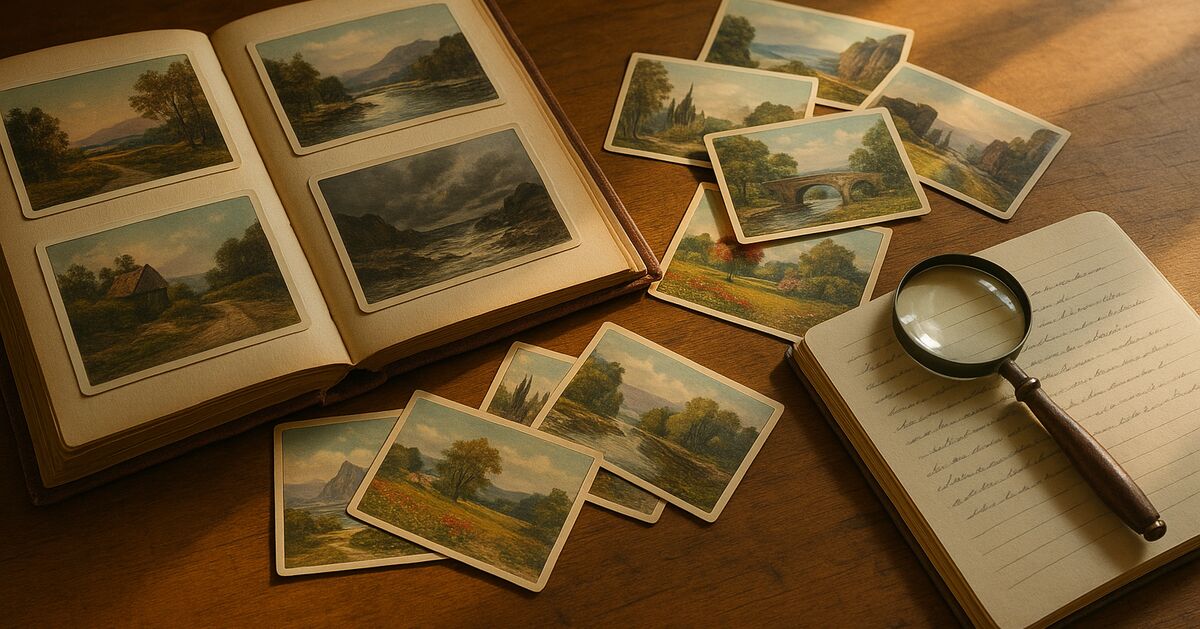
Slow down before you do anything else - that stack of old albums you just inherited deserves at least a few hours of careful attention before a single card changes hands.
For the complete reference, see my guide to inherited postcard collections.
Inheriting a postcard collection can feel overwhelming. You may not know what you are looking at, family members may be pressing you to divide things up quickly, or you may just want to clear the estate and move on. All of that is understandable. Postcards from the early 1900s can vary widely in value, and a modest album of 100 cards may include some surprisingly valuable pieces among the ordinary ones. Rushing the process is the single fastest way to leave real money - or real history - on the table.
This guide walks you through every practical step to take before you sell, split, or donate an inherited postcard album.
Step 1: Do not split the album up yet
The first instinct when dividing an estate among siblings or cousins is to split collections item by item. Resist that with postcards, at least for now.
Albums often have value as a unit. A dealer or serious collector may pay a premium for an intact, thematically consistent album - say, a century's worth of cards from one small town, or a complete travel diary from a single trip to Europe in 1910. The moment you break it apart, that premium disappears and individual cards sell for individual prices. You cannot un-split an album, so the decision deserves some thought first.
Keep the album together, handle it as little as possible, and photograph it before anyone touches it further.
Step 2: Document what you have
Use your phone to photograph every page, without removing any cards. Work in good natural light - bright but not direct sunlight, which creates glare. Photograph:
- The album cover, spine, and inside front cover (inscriptions, names, and dates are clues)
- Each full page in sequence, showing how cards are arranged
- The back of any card that catches your eye (postmarks, messages, and stamps are often more informative than the front)
This record costs you nothing and protects you in several ways. If there is any family disagreement later about what was in the collection, you have visual proof. If anyone looks at the collection for a quote or an appraisal, you have a complete inventory to compare against. And if something gets lost or damaged during the process, you have documentation for insurance purposes.
Number your photos as you go: Page01_front.jpg, Page01_back.jpg, and so on. It sounds tedious but takes less than an hour for a typical album and saves enormous confusion later.
Step 3: Learn the basic vocabulary before talking to anyone
You do not need to become an expert overnight, but knowing a handful of terms will stop you from being talked past - or taken advantage of - in early conversations with any buyer.
Era names matter. Postcard collectors organize history into distinct eras: the Pioneer era (pre-1898), the Private Mailing Card era (1898-1901), the Undivided Back era (1901-1907), the Divided Back era (1907-1915), the White Border era (1915-1930), the Linen era (1930-1945), and the Photochrome era (1945-onward). Cards from the earliest eras in very good condition tend to command higher prices.
Real Photo Postcards (RPPCs) are a separate category. These are photographic prints made directly onto postcard paper, not printed illustrations. They are often the most valuable cards in a mixed collection. The how to tell if an old postcard is a real photo postcard (RPPC) guide on this site walks you through exactly how to identify them - it is worth reading before your first conversation with a buyer.
Condition grading is everything. Collectors use terms like Mint, Excellent, Very Good, Good, Fair, and Poor. Creases, writing on the picture side (not the back), torn corners, album damage from old mounting adhesive, and fading all reduce value. Cards in top condition are generally worth considerably more than worn equivalents, so pay attention to which cards have been handled gently.
Subject matter drives demand. Among postcard collectors, certain subjects carry consistent demand: real photo street scenes, disaster cards (floods, fires, train wrecks), African American history, occupational photos, early aviation and automobiles, Halloween and Santa holiday cards, and cards from small towns that no longer exist. A plain scene of a famous landmark is often worth less than an obscure photo of a now-demolished corner store.
Step 4: Research before you price
Do not guess at value, and do not trust the first number someone volunteers. Spend time on completed sales - not asking prices, but actual sales.
eBay's sold listings (filter by "Sold Items" in the sidebar) are the most accessible free resource. Search for the town name, the postcard type, or the subject matter and look at what comparable cards actually sold for in the last 90 days. This gives you a real-market baseline.
For higher-value cards, look at completed auction records from established postcard auction houses. Several specialize exclusively in paper ephemera and postcards, and their archives are searchable.
Check your local library for a copy of "Linn's World Stamp Almanac" or a dedicated postcard price guide - these go out of date quickly, but they are useful for understanding how dealers think about condition grades and subject premiums.
The FAQ page on this site covers some common questions about valuing inherited collections if you want a quick orientation.
Step 5: Understand what "appraisal" actually means
There is an important difference between a casual dealer opinion and a formal written appraisal, and knowing that difference matters for estates.
A dealer opinion is informal. A dealer looks at the cards and gives you a ballpark. This is useful for deciding whether the collection warrants further attention, but it is not a document you can take to a probate court or use for tax purposes.
A formal written appraisal comes from a qualified appraiser, usually costs a fee, and produces a signed document stating the fair market value of the collection on a specific date. For estate tax purposes, a qualified appraisal is often required for sizable non-cash charitable contributions, and probate courts may ask for similar documentation, so check current rules with a professional. If the collection appears to be worth several thousand dollars or more, a professional appraisal is worth the cost.
Look for appraisers who are members of the American Society of Appraisers or who specialize in paper ephemera and printed Americana. Avoid anyone who offers to appraise and then immediately buy - the conflict of interest there is obvious.
Step 6: Know your main selling paths and their trade-offs
Once you understand what you have, you have real choices. Here is an honest breakdown of each option.
Selling to a dealer is fast and simple. You get cash quickly, the dealer handles everything afterward, and there is no listing, shipping, or waiting. The trade-off is price - dealers need to buy at wholesale so they can resell at retail. Dealer offers are typically a fraction of retail value, often less for common material, so expect a discount rather than full market price. This is not dishonest; it is how the resale business works. Ask any dealer to explain how they reached their number before you accept it.
Selling to a buyer of whole collections by mail works much the same way, without carrying anything anywhere. This is what I do: you describe the collection and add a few photos, I reply by email with a written offer for the whole thing, usually within two business days, and if you accept I send a prepaid, insured shipping label. Payment goes out within two business days of the box arriving, and if the cards turn out different from the description and you don't like my revised offer, I ship everything back free.
Selling at auction - either through a specialized postcard auction house or a general estate auction - puts the collection in front of bidders. The trade-offs are time, since auction cycles can run weeks to months, seller's fees that take a cut of the hammer price, and uncertainty, since results depend on who turns up to bid that day.
Selling directly through eBay, Etsy, or dedicated postcard forums means doing all the work yourself. You photograph, list, answer questions, pack, and ship each card, and many common cards never sell. For a large collection, that can turn into months of evenings.
Whichever path you choose, keep the collection together while you do. A collection with its best cards taken out is worth far less than it was, and the cards left behind are the hardest part to sell on their own.
Step 7: Decide about the collection as a whole
It is tempting to let each relative pick a few favorite cards before anything else happens. Resist that. Picks made by eye almost always take the bright, familiar cards and leave the plain gray photographs, which are often the valuable ones, and a collection with its best cards removed is worth far less than the sum it seemed to hold. I quote complete collections only, and for good reason.
The cleaner path is to decide about the collection as one thing. Get it looked at whole, share the written figure with everyone, and then decide together whether to keep it intact or sell it intact. Put the decision in writing - even a simple email thread works.
Step 8: Store properly while you decide
While you are taking your time with research and appraisal, store the cards correctly. Improper storage causes irreversible damage.
- Keep cards in a cool, dry location away from direct sunlight and humidity
- Avoid attics (temperature swings) and basements (moisture and mold risk)
- If cards are loose, place them in acid-free sleeves or boxes - these are inexpensive and available from archival supply companies
- Do not use rubber bands, paper clips, or tape anywhere near postcard surfaces
- Leave cards in the original album if they are mounted safely; removing them can cause tearing
The blog index on this site has additional guides on handling and storing paper ephemera if you want to go deeper on preservation.
A note on sentimental value versus market value
These two things rarely match, and accepting that early saves a lot of frustration. A card showing your family's home town in 1908 may be deeply meaningful and worth $8 at auction. A garish Halloween postcard of a witch you have never seen before may be worth $150 because it is rare and in beautiful condition. The market does not know your family history - it prices scarcity, condition, and subject demand.
If the collection means a great deal to the family, the simplest answer is to keep all of it together. If the family decides to sell, selling it complete is what gets everyone a fair price for the whole.
Where to learn more
The postcard collecting community is welcoming to newcomers. The Deltiologists of America and the Barr's Post Card News community both have long histories and collectors who are happy to share knowledge. Local postcard shows - usually held in larger cities several times a year - are excellent places to ask questions in person, compare cards to dealer stock, and get informal opinions without any pressure.
If you are just orienting yourself to the world of vintage postcards, the about page explains what this site covers and how to find your way around. And if you have a question that is not covered anywhere you can find, the contact page is the right place to ask.
Here is what matters most: the album you inherited represents real history - someone's travels, a community's past, a century of communication between people who are long gone. Take the time to understand what you have before you disperse it. You may be surprised by what you find, and you will almost certainly make better decisions for it.
About this guide
- Research: Mike Ferreira
- Last reviewed: October 26, 2026
- Claim audit: 5 consequential claims checked against the sources below on Oct 15, 2026; wording the sources could not carry was removed (claim-by-claim)
- Spotted an error? Tell me and I will fix it.
Revision history (3)
- Oct 26, 2026 - Revised so the advice matches how I buy: whole collections, kept together and described as they are.
- Oct 15, 2026 - Owner policy: whole collections only (no keep-back advice)
- Oct 15, 2026 - Pre-publish editorial QA: clean; claim audit: 5 claims, 5 rewritten
A question first?
Ask before you send anything
Not sure the collection is worth a quote, or what to photograph? Just ask. Every message comes straight to me, and I answer each one myself.