What makes a small-town main street postcard valuable
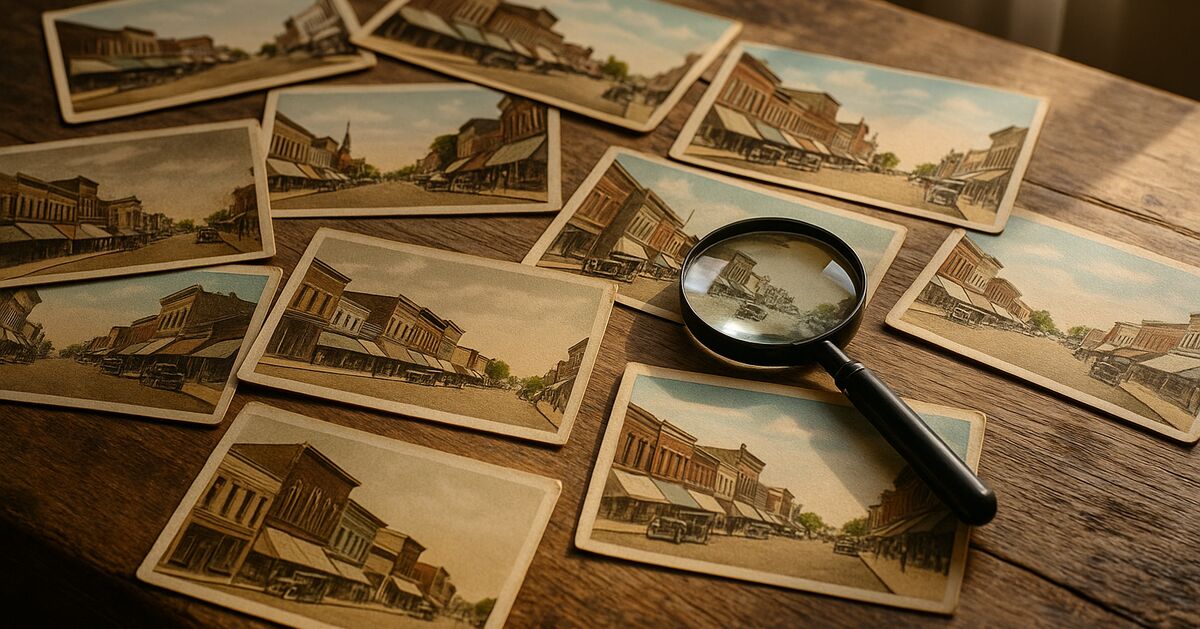
A worn postcard showing a dusty one-block main street in a town nobody has heard of can quietly outbid a glossy card of Times Square at the same auction table - and understanding why is the key to knowing what you actually have in that old shoebox.
Small-town main street postcards occupy a special corner of the hobby. They combine local history, visual documentation, and genuine scarcity in a way that big-city views simply cannot match. A scene from downtown Chicago was printed by the millions. A scene from downtown Gackle, North Dakota likely survives in only a small number of copies worldwide. That arithmetic alone explains a lot - but scarcity is only the beginning of the story.
Why collectors care so deeply about small-town views
Deltiology - the formal name for postcard collecting, which you can read about on the postcard glossary page - has always attracted people who love local history. Main street cards are, at their core, time machines. They show storefronts that burned down, hotels that became parking lots, and barbershops whose signs are still legible a century after the shutter clicked. Local historical societies, genealogists, antique dealers, and pure collectors all want the same cards, which pushes prices up through competition from multiple buyer communities, not just hobbyists.
The demand side matters as much as supply. When four different kinds of buyers are chasing the same image of the 1910 Commercial Hotel on Oak Street in a small Nebraska town, price follows. That overlap of audiences is one reason main street cards regularly punch above their weight at postcard shows and online sales.
The factors that actually move the price
1. Population size of the town
Counterintuitively, smaller usually means more valuable - up to a point. Cards from towns with fewer than 2,000 people at the time of the card's printing were produced in smaller press runs because local demand was limited. Publishers sent salesmen through small towns taking orders; if only thirty merchants and civic boosters ordered cards, only a few hundred were printed. Fewer printed means fewer survive.
Towns of 500 to 2,000 people are often where collector demand is strongest. Very small hamlets (under 200 people) sometimes have high value but also thin collector bases, since fewer people remember or care about the place. Towns in that 500-to-2,000 range usually have enough living descendants and local historians to sustain active demand.
2. Visual content on the street
Not every main street view is equally interesting. Cards that show busy, populated scenes with identifiable businesses are worth more than empty-street compositions. Collectors look specifically for:
- Visible storefronts with legible signage (hardware stores, drugstores, saloons, banks)
- Street-level details: awnings, hitching posts, early automobiles mixed with horse-drawn wagons
- People on the sidewalk or in the street, going about daily life
- Evidence of a specific era - a Model T parked out front, or a trolley line running down the center
- Flags, banners, or decorations suggesting a specific event
A card showing several of those elements at once can often command a much higher price than a plain, empty-street view from the same town and era.
3. Real photo versus printed
Real photo postcards, printed directly on photographic paper rather than lithographed, are usually more valuable than printed versions of the same scene, as they were often made in very small quantities. The real photo postcard value page goes into this in depth, but the short version is: if the card has the texture of a photograph and you can see fine grain under magnification, it is almost certainly a real photo card, and that distinction matters enormously for small-town main streets where the photo run might have been 25 copies rather than 25,000.
4. The era of the card
Many collectors consider the golden age of American postcard printing to run roughly from 1900 to 1930, with peak interest around 1905 to 1918. Cards from that window - especially those printed in Germany before World War I cut off that trade - tend to be the most visually rich and the most sought after. You can learn more about how to date cards from that era on the early 1900s postcards page and through the guide to divided and undivided backs, which is one of the fastest ways to narrow down a card's age.
Linen-era cards from the 1930s and 1940s can also be valuable for small towns, especially if the view is well-composed and the colors are vivid. Chrome-era cards from the 1950s onward are generally less sought after for small-town streets unless the scene itself is exceptional.
5. Publisher and printing quality
For main street cards, the publisher matters less than it does for, say, artist-signed holiday cards - but it still matters. Cards bearing the imprint of a regional publisher with a known reputation for sharp, detailed photography tend to hold their value better. Detroit Publishing Company cards of small western towns, for instance, are prized both for the company's reputation and for the quality of their photo stock. Curt Teich linen-era main street cards with strong color saturation and clear signage also attract steady collector interest. See the pages on Curt Teich postcards and Detroit Publishing Company postcards for more on identifying those imprints.
6. Condition
This goes without saying for any postcard, but it deserves a specific word here: for a scarce small-town main street card, condition requirements relax slightly compared to common subjects - because a collector who has been hunting a particular Nebraska crossroads for fifteen years will accept a lightly creased copy rather than never owning one at all. Even so, a clean, uncirculated copy of the same card will still command a meaningful premium. The postcard condition guide explains grading terminology if you want to evaluate what you have.
Which towns and regions collectors actively compete over
Certain geographic patterns show up again and again among serious small-town main street collectors.
The Great Plains states - Kansas, Nebraska, the Dakotas, Oklahoma, and eastern Colorado - generate fierce competition because the towns were established quickly during the homestead era, many have since shrunken drastically or disappeared entirely, and the photographic record is thin. A main street card from a genuine ghost town on the Nebraska prairie is a documentary artifact as much as a collectible.
Small mountain and mining towns in Colorado, Montana, Idaho, and Arizona attract collectors partly because of the romance of the mining era and partly because so many of those towns experienced boom-and-bust cycles that left the physical streets unchanged for decades after the postcard era ended - meaning the scene shown on the card is sometimes still recognizable today, which adds a specific appeal for people who visit those places.
Texas small towns have a dedicated and well-funded collector base. Texas is a large state with hundreds of small county-seat towns that each had their own main street photographed around 1910 to 1920, and Texas collectors tend to be thorough and competitive.
New England mill towns - particularly in Massachusetts, New Hampshire, Vermont, and Maine - attract collectors interested in industrial history. A main street card that shows a textile mill backdrop or a company-town atmosphere can draw bids from industrial history scholars as well as general collectors.
Southern courthouse-square towns are a distinct sub-category. The classic Southern small town was built around a county courthouse on a central square, and postcard photographers documented those squares repeatedly. Cards that show the courthouse itself alongside the surrounding commercial blocks, with a busy market-day crowd, are particularly desirable.
Specific visual details that dramatically raise value
Beyond the general factors above, a handful of specific details can meaningfully raise a card's value above typical pricing.
- A visible saloon or tavern sign - especially from the years immediately before Prohibition (pre-1920), when those businesses were legal and common on many main streets. Prohibition eliminated them, making pre-Prohibition saloon signage historically significant.
- A barber pole with a readable shop name next to it.
- A bank with its name clearly legible - Many local banks failed during the 1930s, and banking historians and descendants of founders often collect these views.
- An early automobile that can be identified by model and year, which helps date the card precisely and draws automobile history collectors into the bidding.
- A hotel name that matches a known historic property - genealogists searching for the hotel where an ancestor stayed on a particular journey will pay real money for photographic confirmation.
- A lumberyard or grain elevator visible in the background - agricultural history collectors compete for these.
A note on towns that no longer exist
Ghost towns and towns that have merged, been flooded by reservoir construction, or simply faded away command a consistent premium because there is no modern equivalent to compare the card to. The image is the only surviving visual record. Towns flooded by mid-century dam projects - in the Tennessee Valley, along the Missouri River, and in various western river systems - produced main street cards that are now considered primary historical documents. Collectors and historical societies both want them, and the dual-market competition keeps prices elevated.
What to do if you have a collection that includes small-town views
If you have inherited or purchased a collection and you notice cards that show small American towns, resist the urge to write them off as a box of old views without looking closely. A single strong card from a ghost town or a rare real photo main street view can be worth more than fifty common cards combined, so leave it where it is and make sure whoever quotes the collection knows it's there.
The postcard album value page has useful guidance on how to approach inherited collections as a whole. If you want a broader sense of what the market looks like before deciding anything, the postcard price guide is a reasonable starting point, and the are old postcards worth anything page addresses the big-picture question that often comes up first when new to the hobby.
If you are trying to understand what you have before doing anything with it, the how to sell old postcards page walks through the process step by step, including how to describe what you have accurately so a buyer can assess it fairly.
The honest truth about pricing
There is no fixed price list for small-town main street cards, because every card is essentially its own market. A real photo view of a 1912 main street in a surviving Kansas town of similar size might sell in a modest price range. The same quality of card from a town that no longer exists could bring a significantly higher price from the right buyer. A linen-era card of a busy Texas county seat with clear signage and a Saturday crowd tends to sit in a modest price range. The variables compound quickly.
What you can count on: clarity of content, era, real photo status, and town obscurity all push the price up. Printed linen cards of generic empty streets with no readable details sit at the low end. The gap between those poles is real, and learning to see the difference is worth your time before you sell or trade anything.
The collector community for small-town American views is active, enthusiastic, and often deeply knowledgeable about specific regions. If you want to understand where your cards fit, the postcard shows and dealers page explains how that world works, including the regional collectors who have spent years learning which towns are hardest to find.
Small-town main street cards are one of the best arguments for taking the time to look carefully at what you have. The plain-looking card in a stack of fifty might be the one that stops a serious collector cold.
About this guide
- Research: Mike Ferreira
- Last reviewed: October 26, 2026
- Primary references: Government data & agencies 1 (listed below)
- Claim audit: 10 consequential claims checked against the sources below on Oct 19, 2026; wording the sources could not carry was removed (claim-by-claim)
- Spotted an error? Tell me and I will fix it.
Sources & further reading
- USGS Geographic Names Information System: U.S. town name and status records (U.S. Geological Survey)
Revision history (2)
- Oct 26, 2026 - Revised so the advice matches how I buy: whole collections, kept together and described as they are.
- Oct 19, 2026 - Pre-publish editorial QA: 2 flagged, 2 softened; claim audit: 10 claims, 9 rewritten
Claim-by-claim audit (10 checked)
- “A scene from downtown Gackle, North Dakota likely survives in only a small number of copies worldwide.” (rewritten to what the article can stand behind)
- “Cards from towns with fewer than 2,000 people at the time of the card's printing were produced in smaller press runs because local demand was limited.” (reasoning shown in the article)
- “A card showing several of those elements at once can often command a much higher price than a plain, empty-street view from the same town and era.” (rewritten to what the article can stand behind)
- “Real photo postcards, printed directly on photographic paper rather than lithographed, are usually more valuable than printed versions of the same scene, as they were often made in…” (rewritten to what the article can stand behind)
- “Many collectors consider the golden age of American postcard printing to run roughly from 1900 to 1930, with peak interest around 1905 to 1918.” (rewritten to what the article can stand behind)
- “Beyond the general factors above, a handful of specific details can meaningfully raise a card's value above typical pricing.” (rewritten to what the article can stand behind)
- “A real photo view of a 1912 main street in a surviving Kansas town of similar size might sell in a modest price range.” (rewritten to what the article can stand behind)
- “The same quality of card from a town that no longer exists could bring a significantly higher price from the right buyer.” (rewritten to what the article can stand behind)
- “A linen-era card of a busy Texas county seat with clear signage and a Saturday crowd tends to sit in a modest price range.” (rewritten to what the article can stand behind)
- “Many local banks failed during the 1930s, and banking historians and descendants of founders often collect these views.” (rewritten to what the article can stand behind)
A question first?
Ask before you send anything
Not sure the collection is worth a quote, or what to photograph? Just ask. Every message comes straight to me, and I answer each one myself.