How to sell a large postcard collection without lowball offers
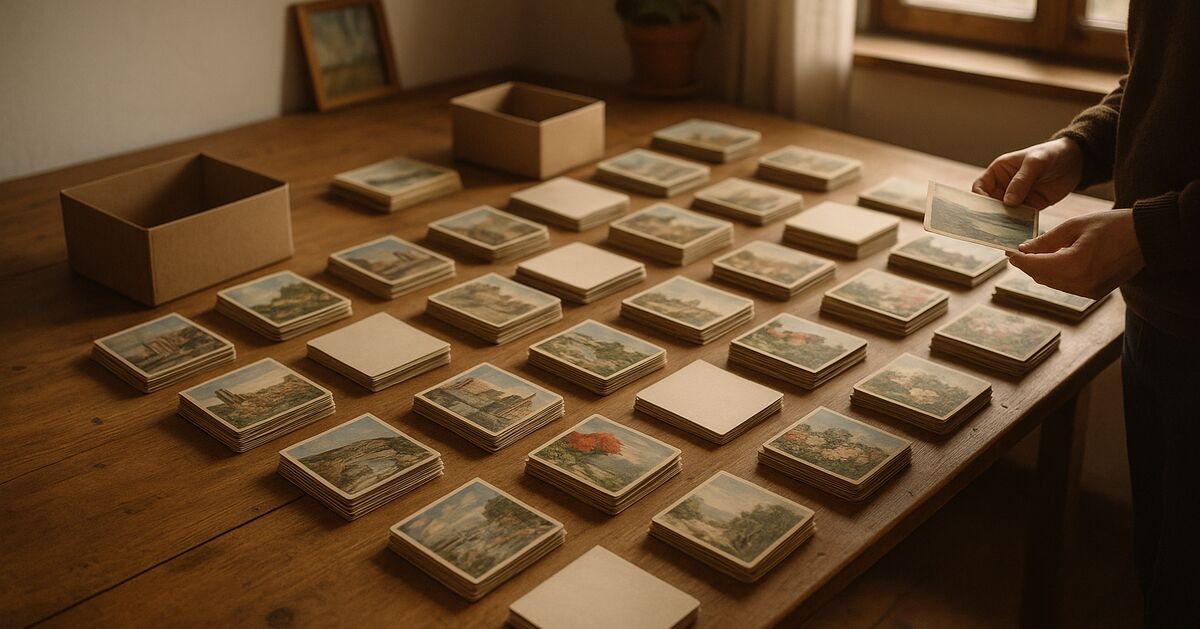
A large vintage postcard collection can be worth a modest sum or a serious one, and the gap between a fair offer and a lowball one often comes down to how well the seller understands what a buyer is looking at. Buyers aren't villains - anyone who buys postcards to resell has real costs - but a seller who knows how offers are built can tell a fair number from a lazy one. Here's what's happening on the other side of the table, and how to present a collection so it gets a proper look.
Why do offers come in lower than you expect?
Before anything else, it helps to understand the economics behind an offer. Anyone who buys a large collection has to:
- Go through, sleeve and catalog every card
- Hold inventory for months or years before the right collector appears
- Pay for show tables, marketplace fees or website costs
- Absorb the cost of the many cards that sell slowly or never sell at all
Those costs are real, and they are why a buyer can't pay retail for every card. Knowing that doesn't mean you should take the first number anyone mentions. It means you can have a sensible conversation about value instead of an awkward silence after a number surprises you.
The sellers who come out best are the ones who keep emotion out of the transaction, describe the collection clearly, and understand which kinds of cards in it carry the value.
What does a buyer look at first?
Hand any experienced buyer a box of cards and watch where their attention goes. They won't read all five hundred cards before forming an impression. In the first few minutes, they're scanning for a handful of signals.
Era and format - Cards from the Golden Age of postcards, roughly 1900 to 1920, get attention faster than chrome-era motel cards from the 1960s. That doesn't mean later cards are worthless - linen postcards from the 1930s and 1940s and chrome postcards from the 1950s and 1960s have their own collector followings - but pre-1920 material carries more weight per card on average.
Real photo postcards - A buyer's pace slows when they reach a real photo postcard (RPPC). These are actual photographic prints on postcard stock, not printed images, and they are usually worth much more than a common printed card. If your collection has a meaningful number of RPPCs, say so up front in your description and photograph a few of them. The guide to real photo postcard values explains what moves the price on these cards.
Topical strength - Buyers think in terms of collector niches. A box of general views is harder to place than a run of railroad and depot postcards, advertising postcards, or occupational postcards. If your collection has a strong topical thread - disaster cards, hold-to-light cards, artist-signed cards - name it when you describe the collection. You don't need to move a single card to do that.
Condition across the group - One beautiful card doesn't make a collection. Offers reflect the condition of the whole lot. Cards with heavy writing on the picture side, creases, corner bends, album adhesive residue, or foxing pull the average down. The postcard condition guide is worth reading before you accept any offer, so you know what a buyer is weighing.
Geographic concentration - A collection built around one county or one small state has a natural audience: local historians, family researchers, and collectors who focus on that place. The postcards by state section of this site shows how geography shapes demand. If your collection has that kind of focus, say so. It's part of what the collection is.
How should you prepare a collection before asking for an offer?
Less than you might think. The most useful preparation is describing the collection well, not rearranging it.
Leave the collection as it is. Keep albums closed and cards where they are. Removing cards from old albums can tear them, especially when they're glued down or held by old photo corners, and an intact album tells a buyer more: who put it together, where they traveled, what they cared about. Re-sorting a box by era or subject feels helpful, but it loses that context and takes hours you don't need to spend. Sorting and counting is the buyer's job.
Don't pick out the best cards. It's tempting to set the real photos or the bright holiday cards to one side. Resist it. Picks made by eye tend to take the familiar, colorful cards and leave the plain gray photographs, which are often the valuable ones. And the cards left behind are the hardest part of any collection to sell on their own. I quote complete collections only, as they are, for exactly these reasons.
Describe what you can see. Roughly how many cards, how many albums or boxes, black-and-white photographs or colored prints, any places or subjects that keep coming up, and anything you know about the dates. Plain words are fine. To estimate a count, count the cards on one album page and multiply by the number of pages, or figure a full shoebox at roughly eight hundred to a thousand cards.
Photograph a sample. A few album pages laid flat, the front and back of some cards that catch your eye, and a wide shot of each box. Good light and no glare make the biggest difference. The back of a card is one of the quickest clues to its age - divided and undivided backs explains how - so a few photos of backs help any buyer date the collection. If there is a run of World War I and II military postcards, or fifty cards from one town, mention it and photograph a page or two of it right where it sits.
Note the condition honestly. If you already know some cards have corner wear, water stains, or heavy cancels, say so. Honesty up front means fewer surprises, and a fair buyer will stand behind an offer that was based on an accurate description.
Write down what you know about where it came from. Was it assembled by one person? Does it connect to a particular town, trade, or family? Provenance doesn't always add money, but it helps a buyer understand the collection, and it's often the part of the story a family most wants to keep.
Should you get an appraisal before you sell?
For a large collection - I'd say anything over a few hundred cards - it's reasonable to want an independent sense of value before you accept an offer. A postcard appraisal from someone with no stake in buying gives you a baseline, and it's the right tool when you need a written valuation for insurance, an estate, or a donation.
You don't have to pay for a formal appraisal in every case. Spending time with the postcard price guide and comparing a few of your cards against recent completed sales on eBay gives you a working sense of retail values. The guide on selling postcards on eBay explains how to read those completed sales correctly - active listings tell you what sellers hope to get; completed sales tell you what buyers actually paid.
Remember that offers for collections are built from wholesale, not retail, so a card that sold for $20 on eBay will fetch well under that inside a collection offer. Knowing the retail number helps you understand the math, not dispute it.
What are the most common mistakes sellers make?
The first is cleaning or "fixing" the cards. Wiping, erasing, flattening, or taping an old postcard almost always does more harm than good. Dust and age toning are expected on cards this old. Leave them exactly as they are.
The second is breaking up the collection before anyone has looked at it. A relative takes a few favorites, a neighbor buys the "good" ones, and what's left is a picked-over box that no one wants to pay much for. You can't un-split a collection, so decide about it as one thing.
Another common problem: reading one price guide and treating every card as if it's the finest example of its type. Price guides and auction highlights show the best, rarest examples. A divided-back small-town main street view in Very Good condition is not the same card as a mint example of the same scene with a clear cancel from a historically significant date. The most valuable kinds of postcards article explains what actually puts a card in the top tier.
The last is accepting an offer you don't understand. A fair offer should come in writing, with a reason. If a buyer won't tell you what drove the number, ask, and if the answer doesn't make sense, you're free to say no.
What are your options for selling a large collection?
There's no single right answer - the best channel depends on the collection and on how much time you want to put in. Here's a straight comparison:
A buyer of whole collections by mail - This is what I do. You describe the collection, add some photos, and get a written offer by email, usually within two business days. If you accept, I email a prepaid, insured shipping label, and I pay within two business days of the box arriving, by PayPal, Zelle, Venmo, or check. If the cards turn out different from the description and my offer changes, you can decline and I ship everything back free. The how it works page walks through every step. There's no obligation and no pressure.
Postcard shows - Bringing a collection to a show lets you talk to several buyers in person. It also means finding a show near you, carrying heavy albums and boxes, and spending the day there. The guide to postcard shows and dealers covers how shows work.
Online marketplaces - eBay, HipPostcard, and Delcampe all have active postcard communities. Selling card by card can bring more per card for the best ones, but it means identifying, photographing, listing, answering questions, and shipping every card yourself, and many common cards never sell. The selling postcards on eBay guide covers the practical mechanics.
Local antique shops and auction houses - These are often close by and easy to reach. Postcards are usually a small part of their business, so ask how they would handle the collection and what their fees are before you hand anything over.
For an overview of the options in one place, the where to sell old postcards page lays them out side by side. And if you'd like a step-by-step walkthrough, how to sell old postcards covers the whole process from first look to final payment.
How long does selling a large collection take?
It's an honest question that sellers sometimes don't ask. Selling a collection whole, by mail, usually takes a week or two from the first form to payment. Selling card by card online takes weeks or months for a collection of several hundred cards, and longer for thousands.
There's no shame in choosing a simple sale. Life circumstances - settling an estate, clearing a house, relocating - often make one clean transaction the right call. What matters is making the choice deliberately, with a clear sense of the trade-off, rather than taking a low offer because you didn't know what the cards were.
Questions people ask
How do I know if an offer is fair?
Ask for it in writing, with a short explanation of what drove the number. Compare a few of your better cards against recent completed sales to get a feel for retail, and expect a collection offer to sit well below that, because the buyer takes on the common cards and all the work. If the explanation makes sense and the buyer stands behind the number, it's in the range of reasonable. You're always free to get other offers first.
Should I sell the best cards on their own and the rest as a lot?
I don't recommend it, and I don't buy collections that way. The cards that look best aren't always the valuable ones, the leftover cards are the hardest part of any collection to sell, and cards taken out of an album lose context that collectors care about. Describe the whole collection as it is, point out the cards you think are special, and get an offer on all of it.
Does it matter if the postcards have been written on and mailed?
Less than many sellers expect. Used cards with clear postmarks and legible messages are often preferred by collectors interested in social history, and the guide to used vs. unused postcards explains the nuances. Heavy ink bleed through to the image side, or writing that obscures the scene, does reduce value - but a clean postmark on the address side of a divided-back card is rarely a problem.
What if the collection is mostly modern chrome cards?
Then expect a modest number. Glossy chrome cards from about 1960 on were printed in huge quantities and have little resale value on their own, though inside a larger, older collection they come along with everything else. If a buyer passes on a chrome-only collection, the what to do with old postcards page covers other good homes for them, from family projects to local historical societies.
About this guide
- Research: Mike Ferreira
- Last reviewed: October 26, 2026
- Primary references: Manufacturer & industry 1 · Tax & legal 1 · Government data & agencies 1 (listed below)
- Claim audit: 4 consequential claims checked against the sources below on Oct 23, 2026; wording the sources could not carry was removed (claim-by-claim)
- Spotted an error? Tell me and I will fix it.
Sources & further reading
- eBay Seller Center: selling collectibles and antiques (eBay Inc.)
- IRS Publication 561: Determining the Value of Donated Property (U.S. Internal Revenue Service)
- National Archives: caring for your collections (paper ephemera) (U.S. National Archives and Records Administration)
Revision history (2)
- Oct 26, 2026 - Revised so the advice matches how I buy: whole collections, kept together and described as they are.
- Oct 23, 2026 - Pre-publish editorial QA: 2 flagged, 2 softened; claim audit: 4 claims, 4 rewritten
Claim-by-claim audit (4 checked)
- “That overhead is real, and it drives dealers to pay well below retail, since they must cover sorting, storage, and selling costs before earning a profit.” (rewritten to what the article can stand behind)
- “These are actual photographic prints on postcard stock, not printed images, and they are typically worth significantly more than a common printed card.” (rewritten to what the article can stand behind)
- “Keep in mind that dealer offers are built off wholesale, not retail, so a card selling for $20 on eBay will typically fetch a dealer offer well below that price.” (rewritten to what the article can stand behind)
- “Compare the offer to what similar cards have sold for in recent completed eBay auctions, then expect the dealer's offer to be meaningfully lower to reflect their costs and margins.” (rewritten to what the article can stand behind)
A question first?
Ask before you send anything
Not sure the collection is worth a quote, or what to photograph? Just ask. Every message comes straight to me, and I answer each one myself.