How to identify and value WWI and WWII patriotic postcards
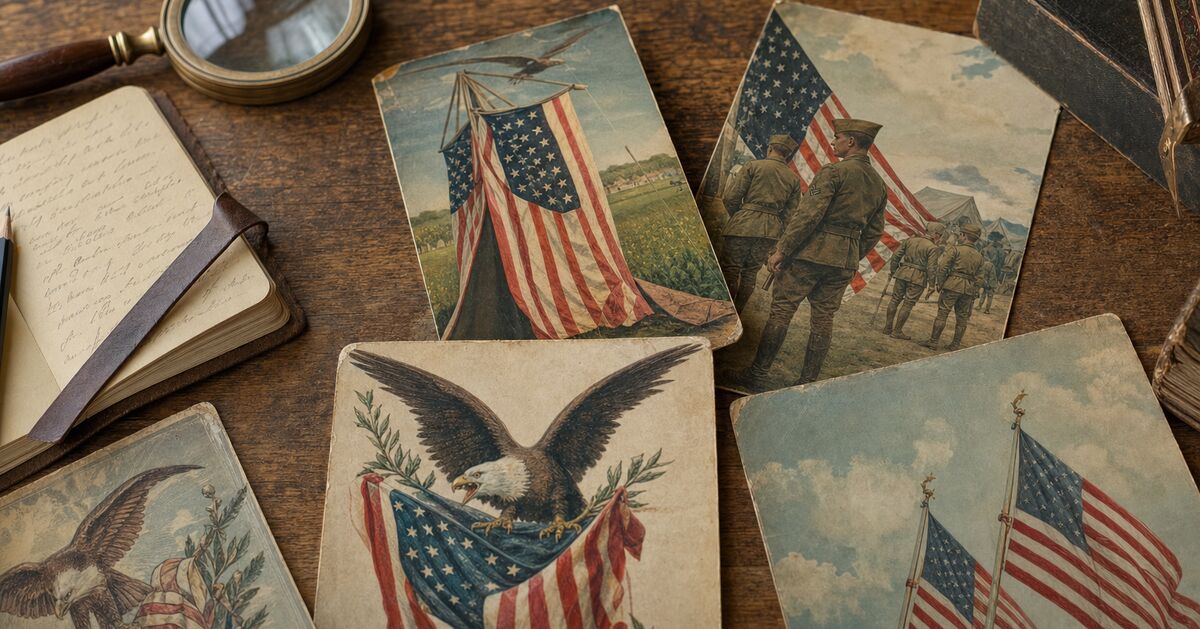
Knowing whether a wartime patriotic postcard is a five-dollar filler or a genuine find comes down to a handful of specific details - the type, the publisher, the subject matter, the condition, and whether the card captures something that was actually rare even when it was new. I'll walk you through both wars, the categories that matter, and the red flags that tell you a card is common.
What makes a WWI or WWII postcard "patriotic"?
The term gets used loosely, so it helps to define what collectors actually mean. A patriotic postcard is any card produced with the primary purpose of expressing national loyalty, mourning, pride, or military solidarity during wartime. That covers a wide range of material:
- Flag imagery (American flags alone, flags with eagles, flags draped over soldiers)
- Portrait-style cards of named or unnamed soldiers, sailors, and nurses
- Allegory cards showing Columbia, Uncle Sam, or Lady Liberty
- Regimental and unit cards listing specific divisions or corps
- Cards printed to benefit the Red Cross or Liberty Bond campaigns
- Cards showing training camps, cantonments, or embarkation ports
- Artist-signed series with overtly patriotic themes
- Hold-to-light cards where a hidden flag or patriotic image appears when held up
Not every card showing a uniform counts. A real photo postcard of a man in uniform is something different from a printed patriotic card, though both can be valuable. I cover the RPPC side of things in my guide to real photo postcard values, and the overlap between the two categories is worth understanding before you price anything.
WWI patriotic postcards: the rare versus the common
What's genuinely common
The years 1914 to 1918 produced an enormous flood of patriotic printing on both sides of the Atlantic. American publishers, taking their cue from European producers, cranked out flag cards and Uncle Sam cards by the millions. Most of these are not rare. Common characteristics of low-value WWI patriotic cards include:
- Generic flag imagery with no specific unit, event, or location
- Mass-market Uncle Sam poses without artist signatures
- Cards printed by minor American publishers on low-quality stock
- "Greetings from Camp ___" cards where the blank was filled in at the post office
- Cards with heavy writing across the image, torn corners, or album-page adhesive damage
A worn generic flag card in poor condition tends to sell for only a small amount at a postcard show. Condition matters enormously in this category - see the postcard condition guide for grading basics before you put a number on anything.
What pushes WWI cards into higher value territory
Several factors can move a WWI patriotic card from the dollar box to the display case:
Artist signatures. Ellen Clapsaddle produced a well-known series of patriotic cards for International Art Publishing around 1917-1918, and signed Clapsaddle patriotic cards reliably attract collector attention. Other signed artists to watch for include Paul Finkenrath (PFB) and cards from the Raphael Tuck wartime series. The guide to Raphael Tuck postcards covers that publisher's production quality and numbering systems in detail.
Hold-to-light (HTL) cards. These mechanically complex cards, where a hidden image appears when backlit, were expensive to produce and are genuinely scarce in the patriotic category. An HTL card with a flag or patriotic motif in excellent condition often sells in a higher price range among specialists, though exact prices vary by sale. Learn more about how these work in the hold-to-light postcards guide.
Named units and specific engagements. A card referencing the 42nd "Rainbow" Division or the American Expeditionary Forces with a specific theater of operations named on the card has a built-in audience of military history collectors, not just postcard collectors. Specificity equals value.
Red Cross and Liberty Bond cards. Cards that were part of official fundraising campaigns - especially those with printed documentation of their purpose - appeal to collectors of both postcards and home-front ephemera.
German-printed cards used by American publishers. Before U.S. entry into WWI in 1917, many American publishers still sourced their printing from Germany. A patriotic card with a German printer's mark on the back is an odd historical artifact that some collectors find irresistible. My guide to German-printed postcards explains how to read those back-marks.
Realistic price range for desirable WWI patriotic cards: Common signed artist cards, $8-$30. HTL patriotic cards in fine condition, $75-$200. Specific unit or campaign cards, $15-$60. Rare publisher series in near-mint, occasionally more.
WWII patriotic postcards: a different market
WWII patriotic cards are a younger category - produced from roughly 1941 to 1945 - and their age puts them squarely in what collectors call the chrome postcard and late linen postcard eras. That matters for value. Cards from this period are less than 85 years old, which means supply is higher and prices are generally lower than comparable WWI material.
What's common in the WWII category
- Generic "V for Victory" cards with no specific subject
- Commercially printed training camp souvenir cards (enormous quantities survive)
- Cards showing the standard military insignia of common branches - Army, Navy, Marines
- Cards with pin-up adjacent imagery but no artist attribution
- Linen cards showing flag imagery without any specific event or unit
A generic patriotic linen card in average condition tends to bring a low price, similar to other common linen-era cards.
What makes a WWII card stand out
Specific military installations and camps, especially those that no longer exist. A linen card of Camp Forrest in Tennessee or a real photo card of a now-demolished base has local history appeal on top of its military interest. The postcards by state audience and the military collector audience overlap here.
Japanese-American internment-adjacent material. Cards showing the relocation centers or postmarked from them are historically significant and attract serious collectors. These are rare to find and sensitive in context.
Named ships and specific naval actions. A card referencing USS _anything_ with the ship's name legible and specific is more desirable than a generic "Our Navy" card.
Home front propaganda imagery. Cards produced for the Office of War Information or related agencies, especially those documenting war bond drives or civilian defense, are primary documents of the home front. They appeal beyond postcard collectors to historians and institutions.
Artist attribution on WWII material. Signed patriotic art from this period is less common than in WWI because mass-production methods had changed. When you find a signed piece, check whether the artist had any broader commercial recognition.
Realistic price range for desirable WWII cards: Good linen camp cards, $5-$20. Named ship or unit cards, $10-$40. Home-front propaganda cards in fine condition, $15-$50. Real photo cards of specific military subjects, see my guide to military postcards for a fuller breakdown.
How to read the back of a wartime patriotic card
The back of a patriotic postcard tells you almost as much as the front. Here's what to look at:
Publisher imprint. Known publishers command premiums. Look for Raphael Tuck, Detroit Publishing, International Art, Paul Finkenrath (PFB), and Curt Teich. Unknown or unlabeled publishers generally mean lower collector interest. My Curt Teich postcards guide covers that publisher's distinctive back marks, and the Detroit Publishing Company guide covers another important name.
Stamp box style. The shape and text of the stamp box on the back is one of the fastest ways to date an undated card. Divided backs with a vertical line down the center generally became standard sometime after 1907. Undivided backs predate that. For WWI cards, look for "Place Stamp Here" boxes that match 1915-1918 printing conventions. The divided back postcards guide explains the timeline.
Postmarks and messages. A used WWI card postmarked from a military training camp or an embarkation port adds historical context and sometimes value, though condition of the front still drives the price. The used vs. unused postcards guide covers how postmarks interact with value in general.
Censor marks. WWII cards mailed from overseas sometimes carry censor tape, censor stamps, or cut-out sections. These are historically significant and actually add to a card's appeal among military collectors, unlike most damage.
Common mistakes when valuing wartime patriotic cards
A pattern that comes up in collector forums again and again is assuming that age alone equals value. A 1918 card is over a hundred years old, but if ten million copies were printed and five million still exist, age doesn't create scarcity. Rarity, subject specificity, condition, and publisher reputation are the real drivers.
Another common error is conflating "military" with "patriotic." A real photo postcard of an unnamed soldier in uniform is not a patriotic card in the collector sense - it's a portrait. Portrait RPPCs have their own market and their own valuation logic, which I cover in the portrait postcards guide. Both categories are worth keeping in a collection as found; pulling them apart by type rarely serves you well.
A third mistake is ignoring the back entirely and pricing from the image alone. Publisher marks, printing codes, and stamp box styles give you dating and attribution information that can double or halve a card's value. Spend as much time on the back as on the front.
Should you keep wartime cards together with the rest of a collection?
If you've inherited or acquired a mixed collection that includes patriotic and military cards alongside other topics, my strong advice is to leave it as you found it. Collections that arrive together have often been assembled by a single eye over decades, and the context of what someone chose to collect alongside these cards can matter to the next collector. Describing the collection as a whole - what topics appear, roughly what era the cards are from, how many pieces are in the collection - gives a buyer or appraiser the full picture. The guide to how to sell old postcards walks through that process step by step.
If you want a general sense of what old postcards are worth before you do anything else, the postcard price guide is a good starting point, and are old postcards worth anything? answers the basic question people ask first.
Questions people ask
Are WWI postcards worth more than WWII postcards?
As a general pattern, yes - WWI material tends to command higher prices because it's older and because the Golden Age of postcards (roughly 1905-1915) overlaps with the early war years, meaning printing quality and artistic ambition were at their peak. WWII cards are more recent, were produced in higher quantities using linen and early chrome printing, and are therefore more common in good condition. That said, a specific, rare WWII subject in excellent shape can easily outprice a generic WWI flag card in poor condition.
What does "patriotic series" mean on the back of a postcard?
When a publisher labeled cards as part of a numbered patriotic series, it usually means they were sold as a set - often six or twelve cards with related imagery. Collectors who specialize in a particular publisher's output actively seek complete series, which means individual cards from a known series sometimes sell at a premium when a collector needs that specific number to finish a set.
Does a postmark from a military base make a card more valuable?
It can, especially if the base is historically significant or no longer exists. A postmark from Camp Upton, New York (a major WWI embarkation point) or from a WWII internment-adjacent location adds primary-source historical weight to a card. The postmark needs to be legible and the card's front needs to be in reasonable condition for the combination to matter much to price.
How do I know if an artist signature on a patriotic card is genuine?
Artist-signed patriotic cards from WWI were produced in large numbered series, and the signature was usually printed as part of the lithographic image rather than hand-applied. That means every card in the series carries the same printed signature - it's not a forgery question so much as a question of whether the artist actually designed the image. Check publisher records and postcard reference books for known series numbers. If a card claims an artist signature but the style looks inconsistent with that artist's documented work, it may be a misattribution by a seller rather than an actual fake.
About this guide
- Research: Mike Ferreira
- Last reviewed: November 2, 2026
- Primary references: Government data & agencies 1 · Manufacturer & industry 1 (listed below)
- Claim audit: 6 consequential claims checked against the sources below on Nov 2, 2026; wording the sources could not carry was removed (claim-by-claim)
- Spotted an error? Tell me and I will fix it.
Sources & further reading
- National Archives: World War I and World War II records and collections (U.S. National Archives and Records Administration)
- American Red Cross (named in this article) (American Red Cross)
Revision history (1)
- Nov 2, 2026 - Pre-publish editorial QA: clean; claim audit: 6 claims, 4 rewritten
Claim-by-claim audit (6 checked)
- “An HTL card with a flag or patriotic motif in excellent condition often sells in a higher price range among specialists, though exact prices vary by sale.” (rewritten to what the article can stand behind)
- “Divided backs with a vertical line down the center generally became standard sometime after 1907.” (rewritten to what the article can stand behind)
- “Desirable WWI patriotic cards can vary widely in price depending on signature, condition, and rarity, with HTL and rare series cards tending to bring the most.” (rewritten to what the article can stand behind)
- “Desirable WWII cards vary in price depending on subject and condition, with named ships, units, and home-front propaganda cards generally bringing more than generic camp cards.” (rewritten to what the article can stand behind)
- “A worn generic flag card in poor condition tends to sell for only a small amount at a postcard show.” (rewritten to what the article can stand behind)
- “A generic patriotic linen card in average condition tends to bring a low price, similar to other common linen-era cards.” (rewritten to what the article can stand behind)
A question first?
Ask before you send anything
Not sure the collection is worth a quote, or what to photograph? Just ask. Every message comes straight to me, and I answer each one myself.