How postcard backs date and value cards from 1893 to 1930
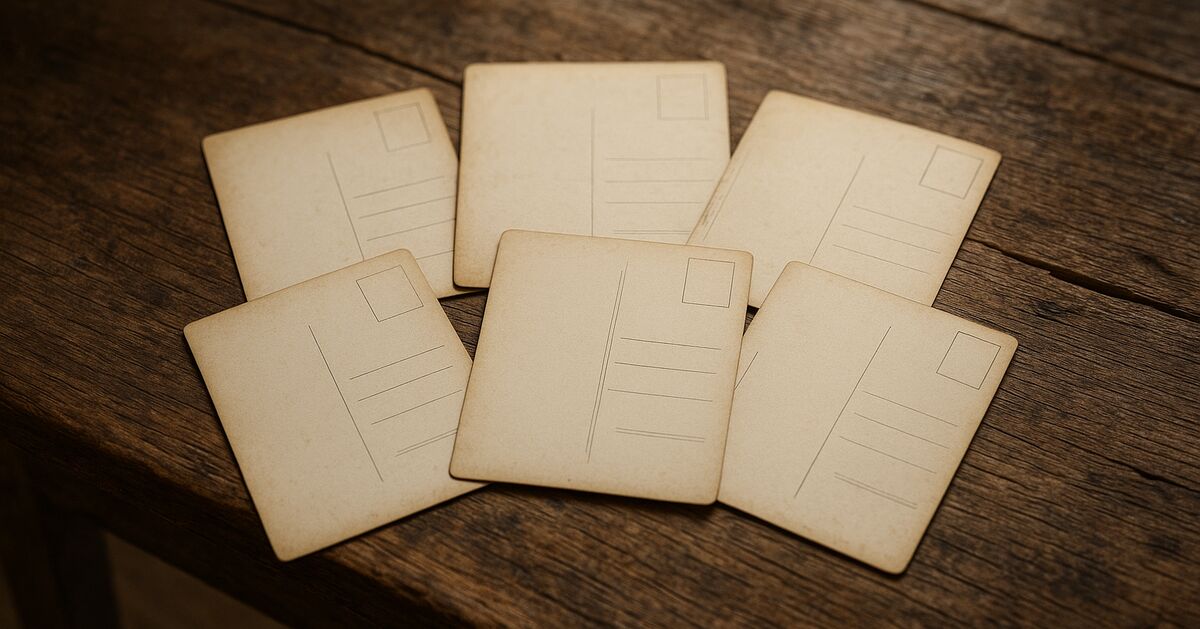
Flip a vintage postcard over and the back is talking to you - if you know the language. The style of the back, the presence or absence of a dividing line, the wording of the address area, and even the size of the stamp box can narrow a card's production date to within a few years. That date can swing a card's collector value dramatically. A card you assume is "just old" might turn out to be a rare Pioneer-era piece worth serious money, or it might be a later reprint worth very little. Reading backs correctly is one of the most practical skills in deltiology - the hobby of postcard collecting.
This guide walks through every major back style produced between 1893 and 1930, explains why each era looks the way it does (the postal regulations that forced the changes), and tells you what each style means for value.
Why the back matters at all
Collectors care intensely about dating because age is one of the strongest drivers of value in the American postcard market. The earliest cards - those produced before about 1898 - are scarce. Production volumes were small, survival rates are low, and the subjects captured on them (storefronts, street scenes, portraits) have not been photographed in any other format that collectors can easily find. By contrast, chrome-era cards from the 1950s and 1960s were produced in very large quantities, and many common views tend to sell for only a dollar or two regardless of condition.
Age alone does not create value, of course. A dull undivided-back view of a blank country road is not worth much more than a dull chrome. But when a desirable subject - a specific depot, a named disaster, an artist-signed holiday card - turns up on an early back style, the combination of rarity and subject matter can push prices into the hundreds or even thousands of dollars. Knowing the back style tells you whether that possibility even exists. You can learn more about how these factors interact in my postcard price guide.
The five major eras of American postcard backs
1. Pioneer era: 1893 to 1898
The first picture postcards widely available to American consumers appeared at the 1893 World's Columbian Exposition in Chicago. The U.S. Post Office had strict rules at the time: only government-issued postal cards could carry the designation "Post Card" and could be mailed for the one-cent postcard rate. Private publishers could produce cards with pictures, but they had to call them "Souvenir Cards" or "Mail Cards," and postage was two cents - the letter rate.
The back of a Pioneer-era card is easy to recognize: it is almost entirely blank except for the printed address lines and a line instructing the sender that the address only may be written on this side. There is no dividing line. There is no space designated for a message - because the postal rules forbade it on the back. Any message the sender wanted to write went on the front, crowded around or over the image.
Authentic Pioneer cards are generally considered among the more valuable cards in the hobby, due to their scarcity. If you find a card with "Souvenir Card" or "Mail Card" printed on the back, a plain address section, and a postmark (or printed date) of 1898 or earlier, treat it carefully. These are the cards worth getting a postcard appraisal for before you do anything else.
What to look for:
- "Souvenir Card," "Mail Card," or nothing at all - never "Post Card"
- No dividing line
- Address area only; message space on the front
- Postmarks 1898 or earlier confirm the era
2. Private Mailing Card era: 1898 to 1901
Congress passed the Private Mailing Card Act in May 1898, which gave private publishers the right to produce cards that could be mailed at the one-cent rate. These are known as "Private Mailing Cards," and publishers were required to print exactly that phrase on the back. The words are typically centered or placed prominently above the address lines.
The rule about messages still applied: nothing but the address could go on the back, so senders still wrote on the front. The back remained simple - address lines, the required phrase, and usually a small decorative flourish or the publisher's name.
These cards are not as rare as Pioneer cards, but they are still early and hold strong collector interest, especially for sought-after subjects. The three-year window (1898-1901) kept production volumes modest.
What to look for:
- The phrase "Private Mailing Card" printed explicitly on the back
- Still no dividing line; address side only
- Postmarks between 1898 and 1901 confirm era
- Publisher imprints often from German printers, who dominated quality color printing at the time (see my overview of German-printed postcards)
3. Undivided back era: 1901 to 1907
On December 24, 1901, the Post Office Department authorized private publishers to use the words "Post Card" on their cards. Almost overnight, "Private Mailing Card" disappeared from backs and "Post Card" took its place. The one-cent mailing rate continued to apply.
But here is the critical detail that defines this entire era: the rule about the address side still forbade written messages. The back could only show the address. The dividing line most people associate with the classic postcard format did not yet exist. This is the "undivided back" - a back with address lines and a "Post Card" designation but no line splitting the space into message and address halves.
Undivided backs ran from 1901 through roughly March 1907. Some publishers used the undivided format a little beyond 1907, and some adopted the divided back slightly before the official change, so postmarks are your best confirmation tool when exact dating matters. Still, spotting "Post Card" with no dividing line and an undivided back gives you a confident range of 1901-1907.
This era overlaps heavily with the early 1900s postcard golden age. Lithographic printing from Germany was at its peak, holiday cards from publishers like Raphael Tuck were being produced in huge variety, and real photo postcards were just emerging. Cards from this era in excellent condition command real premiums, particularly artist-signed, holiday, and occupational subjects.
What to look for:
- "Post Card" printed on the back (two words, sometimes one word "Postcard")
- No dividing line
- Full back given to address only; message on front
- Postmarks 1901-1907
4. Divided back era: 1907 to 1915
On March 1, 1907, the Post Office officially permitted a vertical line dividing the back of a postcard into two halves - address on the right, message on the left. This was the change collectors and publishers had been pushing for, and it transformed the market almost instantly.
Now senders could write a proper message without obscuring the image on the front. Publishers leaned into it; backs began to show the dividing line prominently, along with printed instructions like "This side for the address" and "This side for correspondence." Some publishers added decorative stamps boxes, elaborate borders, or series numbers.
The divided back postcard era (1907-1915) coincides with what historians call the golden age of American postcards. A very large number of cards were mailed during these years, based on the sheer variety of surviving examples. The variety of subjects is enormous: real photo cards of storefronts and disasters, beautifully lithographed holiday greetings, artist-signed fantasy subjects, and local views of every size of town. Demand was so intense that publishers scrambled to keep up.
For the collector, the divided back is the most common early format you will encounter, but "common" does not mean "low value." A divided-back card depicting a now-demolished building, an identified disaster, or a signed piece of art by a recognized artist can still be quite valuable. Context and subject matter drive the price far more than the format alone.
The white border postcard era (roughly 1915-1930) overlaps and eventually succeeds the divided back era, and white border cards also use divided backs, so the dividing line alone does not tell you the exact printing period - you need to look at paper stock, color printing style, and publisher marks together.
What to look for:
- Vertical dividing line splitting the back in two
- "Post Card" or "Postcard" designation
- Postmarks or stamps from 1907-1915 confirm the earliest divided backs
- German-printed cards dominate through 1914; American printing takes over after World War I breaks out
5. White border and transition era: 1915 to 1930
When World War I cut off the supply of German lithographic printing in 1914-1915, American publishers had to produce their own cards. The quality dropped noticeably. To hide uneven ink coverage and reduce paper costs, publishers left a white border around the image on the front. These are the white border postcards - a style that ran from about 1915 through 1930, when linen cards began to take over.
The backs of white border cards are divided, but you will notice differences in printing quality compared to earlier divided-back cards. The paper is often thinner or feels different from German stock. Publisher imprints shifted to American companies. Some backs from this period show bolder, simpler typography because American printers had not yet developed the fine-detail lithographic skill of their German counterparts.
White border cards tend to be valued lower than pre-war divided-back cards of the same subject, though this varies by case. Subjects that were never captured well in later printing eras - small-town main streets, early automobiles, occupational scenes - can be just as desirable on white border stock.
How to use back styles to evaluate a collection quickly
When you are looking through a box or album of old postcards, a quick flip to the back lets you size up the entire group before you spend time examining images:
- No designation, "Souvenir Card," or "Mail Card" with a plain back - Pioneer era. Handle carefully and research every card.
- "Private Mailing Card" printed explicitly - 1898-1901. Treat as potentially valuable; check subjects.
- "Post Card," no dividing line - Undivided back, 1901-1907. Golden age lithography, research each card.
- Vertical dividing line, high-quality color lithography, German imprints - Pre-war divided back, 1907-1914. Strong collector interest.
- Vertical dividing line, white border on the front, American publisher imprints - White border era, 1915-1930. Assess subject matter carefully.
This triage method pairs well with a careful look at postcard condition, because early era cards in poor condition often lose much of their premium over later cards in excellent condition. A bent or creased Pioneer card may be less valuable than a pristine divided-back artist-signed holiday card.
The stamp box: an additional dating clue
Real photo postcards (RPPCs) have their own dating system built into the stamp box shape and style on the back. The stamp box style - whether it is a simple square, has decorative corners, includes "AZO" or "VELOX" or "KODAK" branding, and whether it has a circle or triangle in the corners - can narrow a real photo card's date of production to within a few years. This is a whole subject in itself, covered in my guide to dating real photo postcards by the stamp box.
What early backs mean for value: a realistic summary
No single factor - not back style, not postmark, not publisher - makes a card valuable all by itself. What the back style does is tell you whether a card is even old enough to be in the discussion. A card with a divided back, German lithography, a great subject, and excellent condition is a card worth researching. A card with a divided back, American white border printing, and a generic subject probably is not.
The cards that consistently bring the highest prices in the 1893-1930 range combine:
- Early era (Pioneer, Private Mailing Card, or pre-war undivided/divided back)
- Desirable subject matter (identified people, named disasters, artist signatures, specific local interest)
- Good to excellent condition (no creases through the image, no writing on the front, no missing corners)
- Confirmation of the date from postmarks or stamps when available
If you have a collection that includes cards from these early eras and you are not sure what you have, the most valuable kinds of postcards page is a good next step - it lays out the subject categories that collectors actively compete for. And if you think you may have something worth selling, the how to sell old postcards guide walks you through the process in plain terms so you know what to expect before you commit to anything.
Reading the back of a postcard takes about three seconds once you know what to look for. Those three seconds can be the difference between selling a rare early card for fifty cents at a garage sale and understanding that what you have deserves a real look.
About this guide
- Research: Mike Ferreira
- Last reviewed: October 26, 2026
- Primary references: Manufacturer & industry 2 (listed below)
- Claim audit: 7 consequential claims checked against the sources below on Oct 16, 2026; wording the sources could not carry was removed (claim-by-claim)
- Spotted an error? Tell me and I will fix it.
Sources & further reading
- Postal regulations history: Private Mailing Card Act of 1898 (United States Postal Service)
- U.S. Post Office Department annual reports (historical records) (United States Postal Service)
Revision history (2)
- Oct 26, 2026 - Revised so the advice matches how I buy: whole collections, kept together and described as they are.
- Oct 16, 2026 - Pre-publish editorial QA: clean; claim audit: 7 claims, 4 rewritten
Claim-by-claim audit (7 checked)
- “Congress passed the Private Mailing Card Act in May 1898, which gave private publishers the right to produce cards that could be mailed at the one-cent rate.” (cited → about.usps.com)
- “On December 24, 1901, the Post Office Department authorized private publishers to use the words "Post Card" on their cards.” (cited → about.usps.com)
- “On March 1, 1907, the Post Office officially permitted a vertical line dividing the back of a postcard into two halves - address on the right, message on the left.” (cited → about.usps.com)
- “A very large number of cards were mailed during these years, based on the sheer variety of surviving examples.” (rewritten to what the article can stand behind)
- “By contrast, chrome-era cards from the 1950s and 1960s were produced in very large quantities, and many common views tend to sell for only a dollar or two regardless of condition.” (rewritten to what the article can stand behind)
- “Authentic Pioneer cards are generally considered among the more valuable cards in the hobby, due to their scarcity.” (rewritten to what the article can stand behind)
- “White border cards tend to be valued lower than pre-war divided-back cards of the same subject, though this varies by case.” (rewritten to what the article can stand behind)
A question first?
Ask before you send anything
Not sure the collection is worth a quote, or what to photograph? Just ask. Every message comes straight to me, and I answer each one myself.